

MRI Trolley: Complete Guide to Safe Patient Transport in MRI Facilities
Introduction
In modern healthcare facilities, patient safety is a top priority, especially in specialized imaging environments such as MRI suites. A standard hospital trolley may contain ferromagnetic materials that can become dangerous when exposed to the powerful magnetic field of an MRI machine.
This is where an MRI trolley becomes essential. Designed specifically for magnetic resonance imaging environments, these trolleys help transport patients safely without interfering with imaging equipment or creating safety risks.
Whether you manage a hospital, diagnostic center, or imaging facility, understanding the importance of an MRI trolley can help improve patient care, workflow efficiency, and compliance with MRI safety standards.
Common Problems and Pain Points in MRI Patient Transport
Transporting patients in and around MRI rooms presents unique challenges.
- Risk of magnetic attraction from conventional metal trolleys
- Patient safety concerns during transfer procedures
- Equipment damage caused by incompatible transport devices
- Delays in imaging workflows
- Difficulty moving critical-care patients safely
- Compliance issues with MRI safety regulations
Since MRI systems generate extremely strong magnetic fields, even small metallic objects can become hazardous projectiles. Using MRI-compatible transport solutions helps eliminate these risks.
What Is an MRI Trolley?
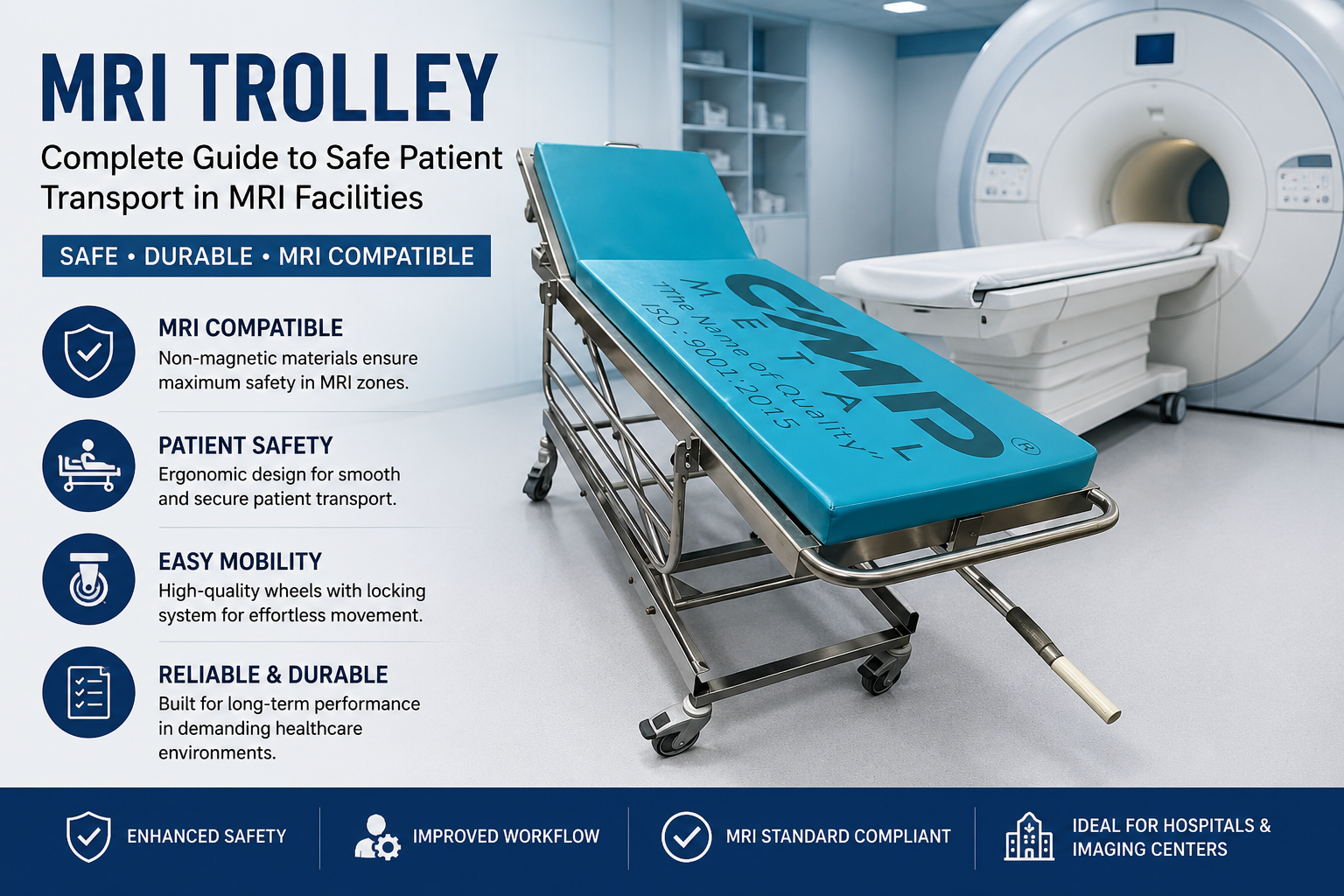
An MRI trolley is a specialized patient transport system designed for use inside MRI environments. These trolleys are manufactured using non-magnetic materials such as:
- Aluminum
- Non-magnetic stainless steel
- High-strength polymers
- Composite materials
An MRI compatible patient trolley allows healthcare professionals to transport patients safely into and out of MRI rooms while maintaining safety standards.
Why MRI-Compatible Transport Equipment Matters
MRI facilities operate differently from other hospital departments because of the continuous magnetic field present around the scanner.
Using dedicated transport wheel trolleys for MRI shifting provides several advantages:
- Enhanced patient safety
- Reduced risk of equipment accidents
- Smooth patient transfer
- Better workflow efficiency
- Compliance with MRI safety protocols
- Reduced operational disruptions
Types of MRI Trolleys
1. Manual MRI Trolley
These trolleys are manually operated and commonly used in diagnostic imaging centers, small hospitals, and outpatient facilities.
2. Hydraulic MRI Trolley
Hydraulic systems allow height adjustment and smoother patient handling, making them ideal for high-volume imaging departments and critical-care units.
3. MRI Compatible Patient Trolley
These trolleys are specifically certified for MRI zones and manufactured using non-magnetic components for maximum safety.
4. Trolley for Moving MRI Magnets
A specialized trolley for moving MRI magnets is designed to transport heavy magnetic components during MRI installation and maintenance projects.
5. Trolley for Moving MRI Equipment
A trolley for moving MRI equipment helps technicians relocate and service MRI systems safely and efficiently.
Key Features of a High-Quality MRI Trolley
- Non-Magnetic Construction: Ensures complete MRI compatibility.
- Smooth Mobility: Easy transportation across hospital floors.
- Locking Mechanism: Improves patient stability during transfers.
- Adjustable Height: Supports ergonomic patient handling.
- Comfortable Patient Surface: Enhances patient comfort.
- Easy Cleaning: Supports infection-control protocols.
- High Load Capacity: Suitable for various patient needs.
Benefits of Using an MRI Trolley
Improved Patient Safety
The primary advantage is eliminating magnetic hazards and ensuring secure patient transportation.
Better Workflow Efficiency
Faster patient transfers reduce delays and improve MRI department productivity.
Enhanced Staff Safety
Medical staff can move patients with greater confidence and reduced physical strain.
Regulatory Compliance
MRI-compatible equipment helps facilities meet healthcare safety standards.
Reduced Equipment Risk
Protects expensive MRI systems from accidental damage caused by incompatible transport devices.
MRI Trolley vs Standard Hospital Trolley
| Feature | MRI Trolley | Standard Hospital Trolley |
|---|---|---|
| MRI Compatibility | Yes | No |
| Non-Magnetic Materials | Yes | Usually No |
| Safe Near MRI Scanner | Yes | Unsafe |
| MRI Safety Compliance | Yes | No |
| Specialized Design | Yes | General Use |
| Risk of Magnetic Attraction | None | High |
Step-by-Step Buying Guide for MRI Trolleys
- Verify MRI Compatibility before purchasing.
- Check Material Specifications to ensure non-magnetic construction.
- Evaluate Load Capacity according to patient requirements.
- Assess Mobility Features such as wheel quality and brakes.
- Consider Ergonomics including height-adjustable options.
- Review Maintenance Requirements for long-term usability.
- Choose Reputable Manufacturers with proven healthcare expertise.
Common Mistakes to Avoid
- Using standard trolleys in MRI zones
- Ignoring MRI compatibility certification
- Choosing products based only on price
- Overlooking wheel and brake quality
- Not checking weight capacity
- Purchasing from unverified suppliers
Expert Tips
- Always prioritize safety over cost.
- Verify MRI-safe or MRI-conditional ratings.
- Train staff on MRI transport procedures.
- Schedule regular inspections.
- Select equipment based on future facility needs.
- Maintain proper cleaning and maintenance schedules.
Conclusion
An MRI trolley is a critical component of safe patient transport within MRI facilities. By using an MRI compatible patient trolley, healthcare providers can improve patient safety, streamline workflows, and comply with MRI safety standards.
Whether you need transport wheel trolleys for MRI shifting, a trolley for moving MRI, or a trolley for moving MRI magnets, choosing the right equipment helps create a safer and more efficient healthcare environment.
Frequently Asked Questions (FAQs)
1. What is an MRI trolley?
An MRI trolley is a non-magnetic patient transport trolley specifically designed for use near MRI scanners.
2. Why can’t standard hospital trolleys be used in MRI rooms?
Standard trolleys often contain ferromagnetic materials that can become dangerous around MRI magnetic fields.
3. What materials are used in MRI-compatible patient trolleys?
They are commonly manufactured using aluminum, non-magnetic stainless steel, polymers, and composite materials.
4. What are transport wheel trolleys for MRI shifting?
These specialized trolleys are used to safely transport patients to and from MRI suites.
5. Are MRI trolleys mandatory in MRI facilities?
They are highly recommended and often required to maintain MRI safety standards.
6. Can MRI trolleys be used for critical-care patients?
Yes, many MRI-compatible patient trolleys are designed for critical-care and emergency transport applications.
7. How do I choose the right MRI trolley?
Look for MRI certification, non-magnetic construction, high load capacity, ergonomic design, and reliable mobility features.