

MRI Compatible Patient Trolley: Safe and Efficient Patient Transport
Introduction
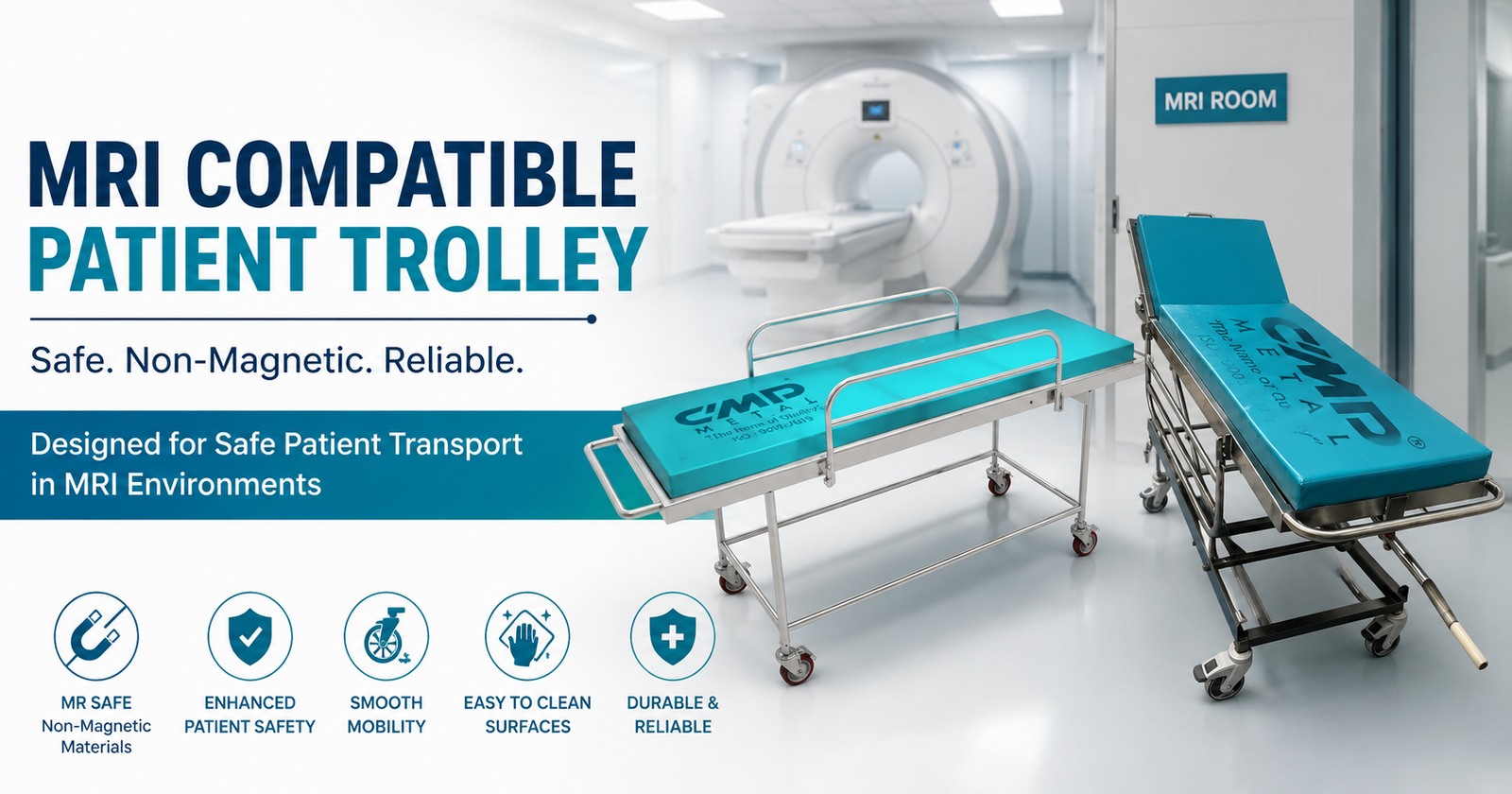
MRI departments require a different approach to patient transportation because the scanner generates a powerful magnetic field. A conventional hospital trolley may contain magnetic materials that can create serious safety risks near the MRI system. An MRI compatible patient trolley is designed to support safer patient movement in MRI areas using suitable materials, construction, and mobility features. For hospitals, emergency departments, and diagnostic centers, selecting the right trolley can improve patient handling, reduce transfer risks, and support a smoother MRI workflow.
AI Overview Summary: An MRI compatible patient trolley is a specialized patient transport system designed for use in MRI environments. It uses appropriately selected non-magnetic or MR-conditional components, stable mobility features, and patient-support surfaces to help healthcare teams move patients safely around MRI facilities.
What is an MRI Compatible Patient Trolley?
An MRI compatible patient trolley is a patient transport trolley specifically designed for use in or around a magnetic resonance imaging environment. Unlike ordinary hospital trolleys, its materials and components must be evaluated for their interaction with the MR environment.
The FDA notes that MRI environments can create risks such as magnetic displacement, torque, heating, device malfunction, and image-quality problems. Equipment intended to enter an MR environment therefore needs appropriate safety evaluation and labeling.
Why is it Important?
MRI scanners use strong static magnetic fields, so unsuitable equipment can become a projectile hazard or otherwise interfere with safe operations. The American College of Radiology recommends structured MR safety policies covering equipment, objects, patients, and personnel.
A dedicated trolley can help hospitals:
- Move patients between wards and MRI areas more efficiently.
- Reduce the risk associated with unsuitable transport equipment.
- Support transfers for patients with limited mobility.
- Improve workflow in busy diagnostic imaging departments.
- Provide a controlled platform for patient transportation.
Key Features
A suitable MRI transport trolley may include:
- MR-compatible construction: Materials and components are selected according to the specified MR environment and safety requirements.
- Stable caster system: Smooth movement and reliable braking help control the trolley during patient transfers.
- High load capacity: Supports patients safely according to the specified working load.
- Patient safety features: Side rails, secure mattress surfaces, and locking mechanisms can improve transfer safety.
- Easy-clean surfaces: Smooth surfaces simplify routine cleaning and infection-control procedures.
- Ergonomic design: Appropriate height and handling features can reduce unnecessary physical strain on staff.
- Custom configuration: Dimensions and accessories can be adapted to hospital workflow where appropriate.
Benefits
- Improved patient safety: Helps reduce hazards associated with unsuitable equipment around MRI systems.
- Faster patient movement: Makes transfers between departments more organized.
- Better staff handling: Designed mobility can make patient transportation easier.
- Reduced workflow interruptions: Dedicated equipment helps MRI teams avoid unnecessary equipment changes.
- Hygienic operation: Easy-to-clean surfaces support healthcare cleaning procedures.
- Flexible use: Appropriate designs can serve hospitals, imaging centers, and critical-care transport needs.
Applications
MRI-compatible patient transport solutions are useful in:
- Hospitals and multi-specialty hospitals
- Emergency and trauma centers
- ICU and critical-care units
- Operation theatres
- Diagnostic imaging centers
- Clinics and nursing homes
- Medical colleges and teaching hospitals
- Government and private healthcare institutions
Specialized transport wheel trolleys for MRI shifting can be used when patients need controlled movement to and from MRI areas. Equipment intended for moving MRI system components or magnets is a different application and should not be confused with a patient trolley.
How to Choose the Right MRI Compatible Patient Trolley
- Verify MR status: Check whether the trolley is MR Safe or MR Conditional and understand the exact conditions of use.
- Check the material specification: Do not rely only on terms such as “non-magnetic”; request appropriate technical documentation.
- Match the load capacity: Select a model suitable for the maximum expected patient weight and equipment load.
- Evaluate dimensions: Ensure the trolley fits through doors, corridors, transfer areas, and the intended MRI workflow.
- Check mobility and brakes: Wheels should provide controlled movement and secure positioning.
- Review hospital requirements: Consider side rails, height adjustment, mattress type, cleaning needs, and other required accessories.
The FDA advises that MR Conditional equipment is safe only when used according to its specified conditions.
Common Mistakes to Avoid
- Assuming every stainless-steel trolley is automatically MRI compatible.
- Buying without checking documented MR safety status.
- Focusing only on price instead of safety specifications.
- Ignoring trolley dimensions and patient load capacity.
- Using a standard hospital trolley inside an MRI-controlled area.
- Confusing a trolley for moving MRI magnets with a patient transport trolley.
- Failing to involve the hospital’s MR safety personnel before introducing equipment.
Conclusion
An MRI compatible patient trolley is an important part of safe patient transportation in MRI facilities. The right model combines suitable materials, stable mobility, patient-support features, and clearly defined MR safety conditions. Hospitals should evaluate the trolley against their MRI zone requirements, patient needs, and internal safety procedures before purchase. For specifications, customization options, or product guidance, healthcare procurement teams can contact the manufacturer and request detailed technical information.
Frequently Asked Questions
What is an MRI compatible patient trolley?
An MRI compatible patient trolley is a specialized transport trolley designed for patient movement in an MR environment. Its materials and components are selected and evaluated according to applicable MRI safety requirements. The exact MR status and conditions of use should always be verified from the manufacturer’s documentation before the trolley enters an MRI-controlled area.
What are the benefits of an MRI compatible patient trolley?
The main benefits include safer patient transportation, controlled movement, easier transfers, improved workflow, and reduced risk from unsuitable equipment near MRI systems. Features such as stable wheels, brakes, side rails, suitable patient support, and easy-clean surfaces can further improve day-to-day usability in hospitals and diagnostic imaging departments.
Where is an MRI compatible patient trolley used?
It is primarily used in MRI departments, diagnostic imaging centers, hospitals, emergency areas, and other healthcare environments where patients must be transported to or from an MRI examination. The trolley’s specific MR status determines where it can safely be used, so facilities should follow the manufacturer’s conditions and their own MR safety procedures.
How do I choose the right MRI compatible patient trolley?
Start by checking the trolley’s documented MR safety status and conditions of use. Then evaluate load capacity, dimensions, wheel and brake performance, patient-support features, cleaning requirements, and compatibility with the hospital’s workflow. It is also important to confirm that the trolley can be safely used in the intended MRI zone.
Is an MRI patient trolley customizable?
Yes, some manufacturers can customize dimensions, patient-support features, side rails, height, wheel configuration, and other design elements according to healthcare requirements. However, customization should not be assumed to retain the original MR safety status. Any modified configuration should be properly evaluated and documented before use in an MR environment.
What material is best for an MRI compatible trolley?
There is no single material that is automatically best for every MRI application. Materials and components should be selected according to the intended MR environment and required safety status. Aluminum, suitable non-magnetic materials, polymers, and other appropriately evaluated components may be used depending on the design and manufacturer’s specifications.