

Crash Cart Trolley: Equipment List, Benefits, Uses and Buying Guide
Introduction
In hospitals, emergencies can develop within seconds, leaving very little time to search for essential medicines or medical equipment. A crash cart trolley keeps critical resuscitation supplies organized and close to the patient-care area. From emergency departments and ICUs to operation theatres and wards, a properly arranged trolley helps trained healthcare professionals access the required equipment quickly. WHO guidance emphasizes keeping emergency equipment, medicines and supplies accessible, clearly labelled and logically organized, with regular checks and replenishment.
AI Overview Summary:
A crash cart trolley is a mobile emergency medical cart that stores essential resuscitation equipment, medicines, consumables and accessories in an organized layout. It is used by trained healthcare professionals during cardiac arrest and other medical emergencies to provide rapid access to life-saving supplies.
What is a Crash Cart Trolley?
A crash cart trolley is a mobile medical storage unit designed to keep emergency medicines, resuscitation equipment, consumables and related accessories readily available.
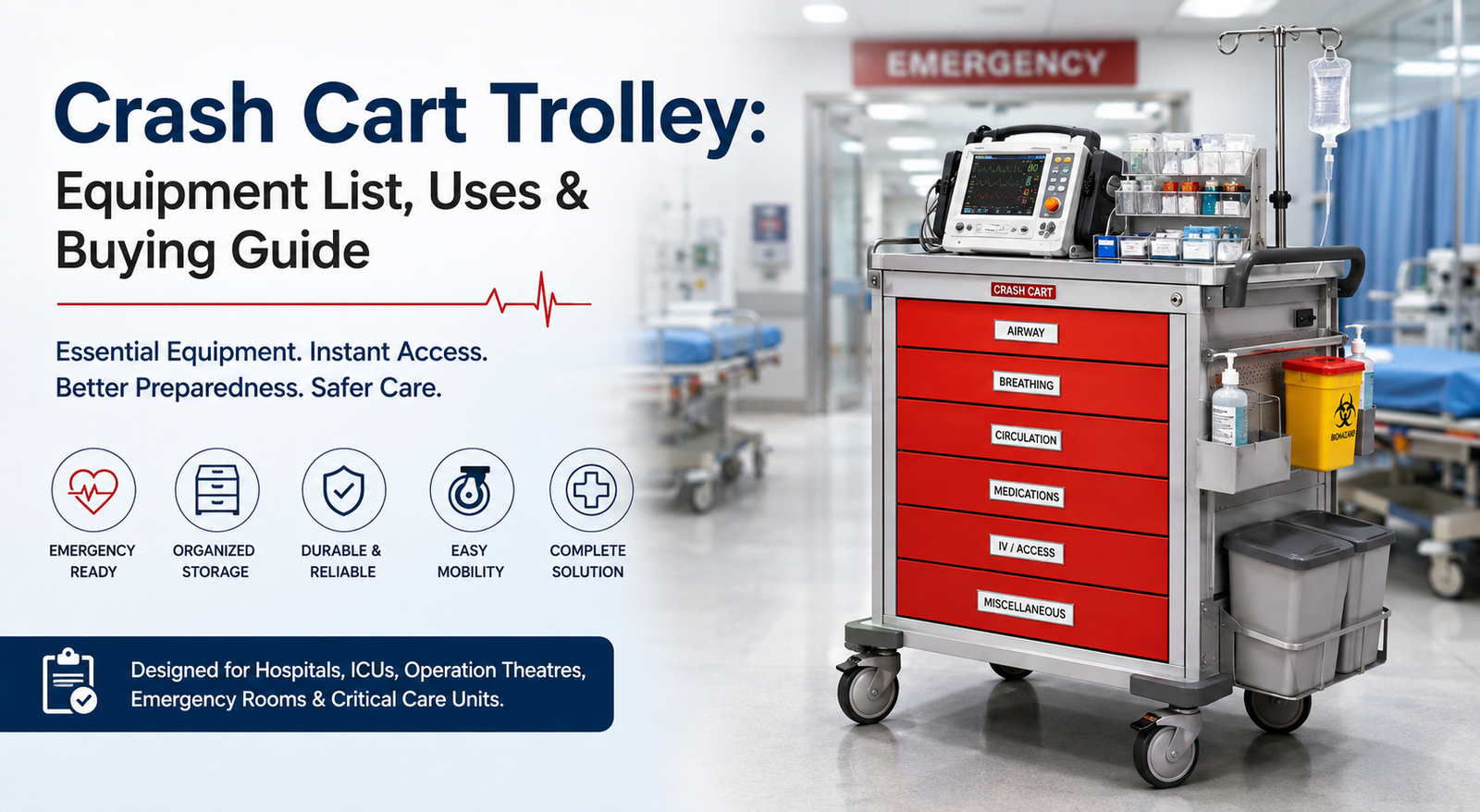
It typically includes multiple drawers, compartments, a work surface, wheels with brakes and dedicated spaces for equipment such as a defibrillator, oxygen accessories or suction equipment.
The exact contents should be determined by the healthcare facility’s clinical protocols, patient population and applicable regulations. WHO emergency equipment guidance includes items such as bag-valve-mask resuscitators, oxygen sources, suction equipment, blood-pressure equipment and airway supplies.
Why is it Important?
During a medical emergency, organization can directly affect how quickly trained staff can begin appropriate treatment. A crash trolley brings commonly required emergency supplies into one mobile location instead of distributing them across different storage areas.
It can be positioned in emergency rooms, ICUs, wards, operation theatres and other designated clinical areas. WHO recommends organized resuscitation areas where staff, equipment and medicines are kept close at hand for emergency interventions.
Key Features of a Crash Cart Trolley
- Multiple drawers: Separates medicines, airway supplies, IV consumables and other equipment.
- Mobile castors: Allows the trolley to be moved quickly to the required location.
- Central locking system: Helps control access to emergency medicines and supplies.
- Breakaway seal option: Supports quick access while helping staff identify unauthorized opening.
- Defibrillator platform: Provides a stable location for compatible emergency cardiac equipment.
- Oxygen-cylinder provision: Allows suitable configurations to accommodate oxygen equipment where required.
- IV pole: Provides convenient support for intravenous fluid administration.
- Smooth worktop: Offers a practical surface for emergency preparation and procedures.
- Easy-clean construction: Helps support routine cleaning and infection-control practices.
Benefits of a Crash Cart Trolley
- Faster access: Essential supplies can be located without searching multiple storage areas.
- Better organization: Clearly assigned drawers reduce confusion during high-pressure situations.
- Improved readiness: Standardized layouts make routine checking and replenishment easier.
- Mobility: The trolley can be moved closer to the patient when clinically required.
- Inventory control: Designated compartments make missing or depleted items easier to identify.
- Workflow support: Staff can follow a consistent arrangement across different clinical areas.
Applications
Crash trolleys are commonly used in:
- Emergency departments and casualty areas
- Intensive Care Units and critical-care units
- Operation theatres and recovery rooms
- General hospital wards
- Cardiac-care areas
- Clinics and medical institutions
- Government and private hospitals
- Ambulance or emergency-care environments, where an appropriately configured mobile cart is suitable
The contents may differ between adult, paediatric, maternity and specialty-care settings. WHO guidance, for example, recommends appropriately sized equipment and supplies for paediatric emergency care.
How to Choose the Right Crash Cart Trolley
When preparing a crash cart trolley list or comparing suppliers, consider these points:
- Define the clinical requirement: Decide whether the trolley is for adult, paediatric, ICU, OT or general emergency use.
- Plan the drawer layout: Check whether the compartments can accommodate your emergency trolley equipment list and preferred medicine arrangement.
- Check construction quality: Stainless steel is widely preferred where durability, cleanability and resistance to corrosion are important.
- Review mobility: Choose suitable medical-grade castors, reliable brakes and a stable frame.
- Consider security: Evaluate central locking, breakaway seals and other access-control requirements.
- Confirm customization: Hospitals may need customized drawer configurations, accessories, dimensions or equipment supports.
Common Mistakes to Avoid
Avoid selecting a trolley based only on appearance or the number of drawers. A model that cannot accommodate the hospital’s actual equipment and crash cart medicine list may create problems later.
Another common mistake is failing to establish responsibility for regular inspection. WHO guidance recommends checklists, functionality checks and replenishment processes to reduce the risk of missing emergency supplies.
Facilities should also avoid assuming that one universal medicine list works everywhere. Emergency medications and quantities should follow the facility’s approved clinical protocols and applicable requirements.
Conclusion
A well-designed crash cart trolley provides a practical way to organize emergency equipment, medicines and consumables for rapid access by trained healthcare professionals. Its value depends not only on the trolley itself, but also on logical arrangement, appropriate equipment selection, security and regular inspection.
Hospitals and healthcare procurement teams should evaluate the trolley against their clinical workflow, patient population and storage requirements. For specifications, customization options or assistance in selecting a suitable hospital crash cart configuration, contact the manufacturer for detailed product information.
FAQ
What is a crash cart trolley?
A crash cart trolley is a mobile medical cart used to store emergency medicines, resuscitation equipment, consumables and accessories. It is positioned in designated clinical areas so trained healthcare professionals can quickly access essential supplies during cardiac arrest and other emergencies.
What equipment is kept in a crash cart?
A typical emergency trolley equipment list may include a bag-valve-mask resuscitator, oxygen accessories, suction equipment, airway devices, IV supplies, syringes, gloves and monitoring equipment. The exact contents vary according to hospital protocols, patient population and clinical department. WHO provides generic emergency equipment guidance that facilities can adapt to their needs.
What is included in a crash cart medicine list?
A crash cart medicine list generally contains emergency medications selected according to the facility’s approved protocols and patient-care requirements. There is no single universal medicine list suitable for every hospital. Medicines should be selected, stored, labelled and checked according to applicable clinical policies and regulatory requirements.
What is the difference between crash cart equipment and accessories?
Crash cart equipment generally refers to clinical or resuscitation items required for emergency care, such as airway and oxygen equipment. Accessories are supporting components such as IV poles, drawer dividers, seals, holders, waste containers and equipment mounts that improve organization and usability.
What material is best for a crash cart trolley?
Stainless steel is a common choice for hospital crash carts because it offers durability, corrosion resistance and a smooth surface that can be cleaned efficiently. The appropriate material ultimately depends on the clinical environment, cleaning procedures, design requirements and hospital procurement specifications.
How often should a crash cart be checked?
Crash carts should be checked according to the healthcare facility’s approved policy and applicable requirements. Checks commonly verify equipment functionality, medicine and consumable availability, security seals and organization. WHO guidance recommends regular functionality checks and replenishment, with defined responsibility for verification.