

Crash Cart Trolley: Complete Guide to Emergency Equipment and Organization
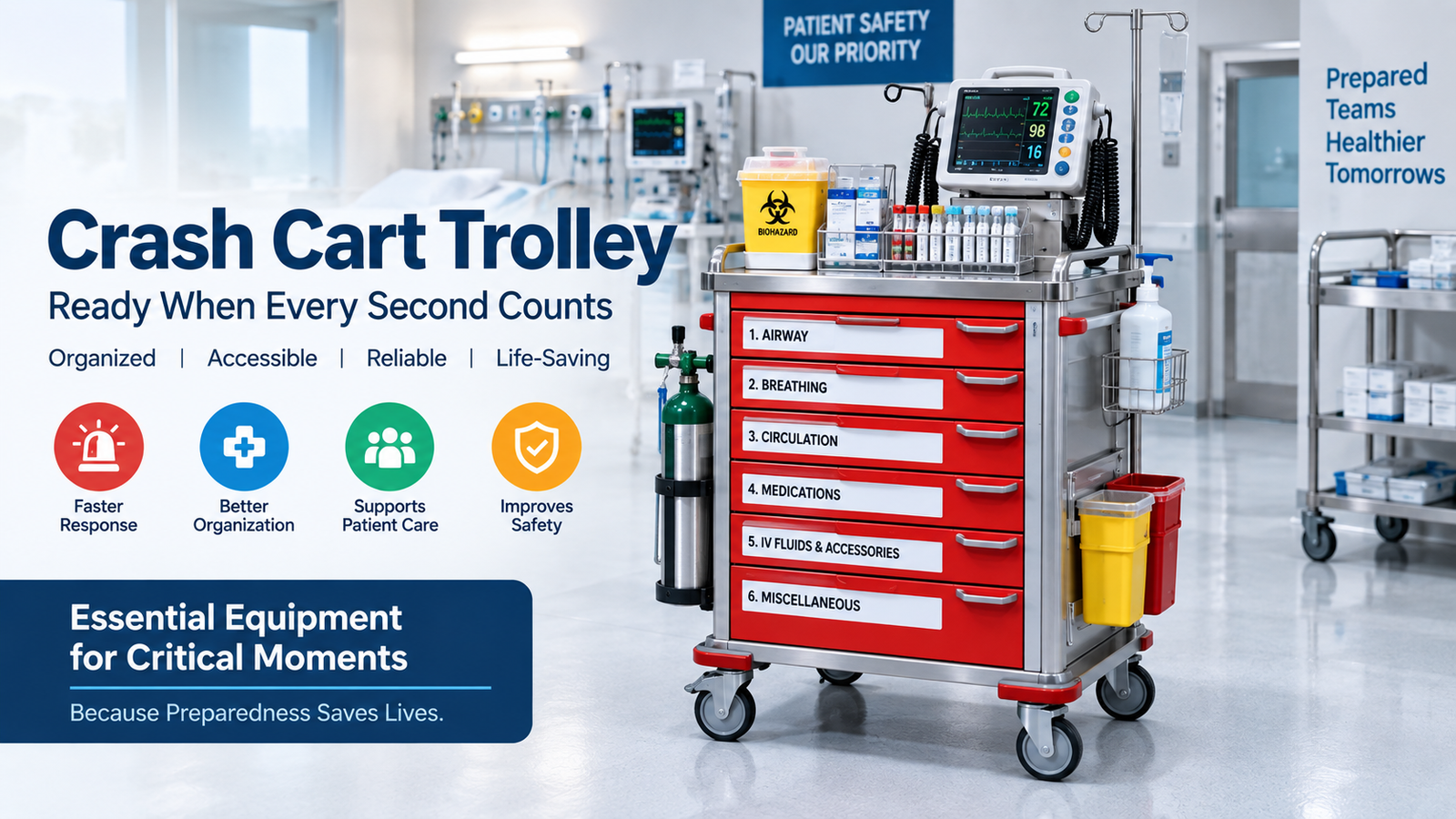
In hospitals, emergencies can happen without warning, and healthcare teams need essential equipment within reach. A crash cart trolley provides a mobile, organized storage solution for emergency medicines, devices, and clinical supplies used during critical situations. Instead of searching through multiple storage areas, staff can move the trolley directly to the patient-care location. For hospitals, clinics, ICUs, operation theatres, and healthcare procurement teams, choosing the right trolley and maintaining its contents properly can support faster and more organized emergency response.
A crash cart trolley is a mobile emergency medical trolley that stores essential medicines, airway and circulation equipment, monitoring accessories, and other supplies in an organized layout. It allows trained healthcare professionals to access required emergency resources quickly and move them to the point of care.
What Is a Crash Cart Trolley?
A crash cart trolley, sometimes informally called a crash card trolley, is a purpose-built mobile trolley used in hospitals and healthcare facilities for emergency preparedness.
Its drawers and compartments can be arranged according to the facility’s approved emergency protocols. Depending on the clinical area, the trolley may contain emergency medicines, airway equipment, IV supplies, resuscitation accessories, and monitoring equipment.
The exact crash cart trolley medicine list and equipment configuration should be determined by the hospital’s clinical team and applicable protocols rather than using one universal list for every facility.
Why Is It Important?
During a medical emergency, unnecessary searching can delay access to essential resources. A properly organized trolley gives trained staff a designated location for emergency supplies.
A crash cart can be particularly useful in:
- Intensive Care Units
- Emergency departments
- Operation theatres
- Patient wards
- Recovery areas
- Clinics and medical institutions
Consistent organization also helps staff become familiar with where specific items are stored. This is why proper crash cart management is an important part of emergency preparedness.
Key Features of a Crash Cart Trolley
The design should support quick access, mobility, cleaning, and organized storage.
- Multiple drawers: Separate medicines, airway supplies, IV accessories, and other emergency items.
- Smooth-rolling castors: Allow the trolley to be moved quickly between patient-care areas.
- Durable construction: Supports frequent use and routine cleaning.
- Central locking system: Helps secure drawers and stored supplies when appropriate.
- Work surface: Provides a practical area for preparing equipment during an emergency.
- Accessory mounting: Can accommodate selected holders, IV poles, oxygen-cylinder supports, or other accessories.
- Defined drawer arrangement: Helps staff locate supplies consistently.
Benefits of a Crash Cart Trolley
A properly selected and maintained trolley can provide several practical benefits.
- Faster access: Essential supplies remain organized in one mobile unit.
- Better workflow: Staff can follow a consistent storage arrangement.
- Improved mobility: The trolley can be moved directly to the required clinical area.
- Simpler inspections: Staff can check the contents against an approved checklist.
- Efficient space use: Multiple emergency supplies can be stored in a compact footprint.
- Standardized organization: Similar arrangements can make emergency response procedures easier to follow.
The benefits depend heavily on proper stocking, inspection, maintenance, and staff familiarity with the trolley.
Applications of Crash Cart Trolleys
Crash carts are used in healthcare environments where immediate access to emergency equipment may be required.
Typical applications include:
- Hospitals and government hospitals
- Intensive Care Units
- Emergency and trauma departments
- Operation theatres
- Patient wards
- Recovery rooms
- Clinics
- Medical colleges and institutions
- Specialized healthcare facilities
The configuration can differ between departments. An ICU may require a different crash cart equipment arrangement than a general ward.
How to Choose the Right Crash Cart Trolley
Healthcare procurement teams should evaluate the trolley against actual clinical and facility requirements.
1. Review the Intended Application
Determine where the trolley will be placed and which emergency supplies the department needs to store.
2. Check Drawer Capacity
Review the expected emergency trolley equipment list before selecting the number and size of drawers.
3. Evaluate Construction
Look for durable, easy-to-clean materials that can withstand regular hospital use.
4. Check Mobility
Castor quality, wheel size, maneuverability, and overall stability are important for moving the trolley safely.
5. Review Security
Consider suitable locking arrangements for medicines and other controlled supplies according to hospital policy.
6. Consider Customization
Hospitals may require customized drawer layouts, dimensions, accessories, or finishes to suit specific departmental requirements.
Common Mistakes to Avoid
One common mistake is selecting a trolley based only on appearance or price without checking its storage requirements. A trolley that cannot accommodate the department’s approved crash cart trolley list may create organizational problems.
Another mistake is using the same arrangement for every clinical department without considering different workflows.
Facilities should also avoid overcrowding drawers, unclear labeling, irregular inspections, and inconsistent restocking. The trolley should be checked according to the hospital’s approved crash cart trolley medicine list, equipment requirements, and emergency trolley checklist.
Conclusion
A crash cart trolley provides hospitals with a practical way to organize and move essential emergency equipment and supplies. Its value depends not only on construction and design but also on proper drawer organization, stocking, inspection, cleaning, and staff familiarity.
Hospitals, clinics, government healthcare facilities, and procurement departments should select a trolley based on their clinical workflow and approved emergency requirements. For projects requiring specific dimensions, drawer arrangements, materials, or accessories, healthcare equipment manufacturers can help develop a configuration suited to the facility.
Frequently Asked Questions
What is a crash cart trolley?
A crash cart trolley is a mobile medical trolley designed to organize emergency medicines, equipment, and clinical supplies. It allows trained healthcare professionals to move essential resources to the patient’s location during a critical situation. Its contents and drawer arrangement should follow the healthcare facility’s approved emergency protocols.
What is included in a crash cart trolley?
Contents vary by hospital, department, and clinical protocol. A typical configuration may include emergency medicines, airway-management supplies, IV accessories, circulation-related equipment, monitoring accessories, and other resuscitation supplies. Healthcare facilities should maintain their own approved equipment and medicine lists rather than relying on a generic list.
What is a crash cart trolley medicine list?
A crash cart trolley medicine list is the facility-approved list of emergency medicines intended to be stored in the trolley. The exact medicines, quantities, storage requirements, and checking procedures should be established by qualified clinical staff according to the hospital’s policies and applicable requirements.
Where is a crash cart trolley used?
Crash cart trolleys are commonly used in hospitals, ICUs, emergency departments, operation theatres, patient wards, recovery areas, clinics, and medical institutions. The trolley configuration can vary according to the clinical environment, patient population, emergency procedures, and equipment required in that particular department.
How do I choose the right crash cart trolley?
Start by identifying the department, required equipment, drawer capacity, available space, mobility requirements, construction material, and security needs. Procurement teams should also consider cleaning, maintenance, accessory requirements, and whether a customized drawer arrangement would better support the facility’s emergency workflow.
Can a crash cart trolley be customized?
Yes, medical equipment manufacturers may offer customized configurations depending on project requirements. Customization can include trolley dimensions, drawer sizes, drawer layouts, locking systems, IV poles, oxygen-cylinder holders, accessory brackets, and other features. The final design should be based on the healthcare facility’s approved operational requirements.
What material is suitable for a crash cart trolley?
The appropriate material depends on the hospital’s requirements, cleaning practices, durability expectations, and budget. Healthcare facilities commonly consider materials that are durable, corrosion-resistant, smooth, and easy to clean. Procurement teams should evaluate the complete construction rather than selecting a material based on one specification alone.