

Crash Cart Equipment: Essential Guide for Hospitals and Healthcare Facilities
Introduction
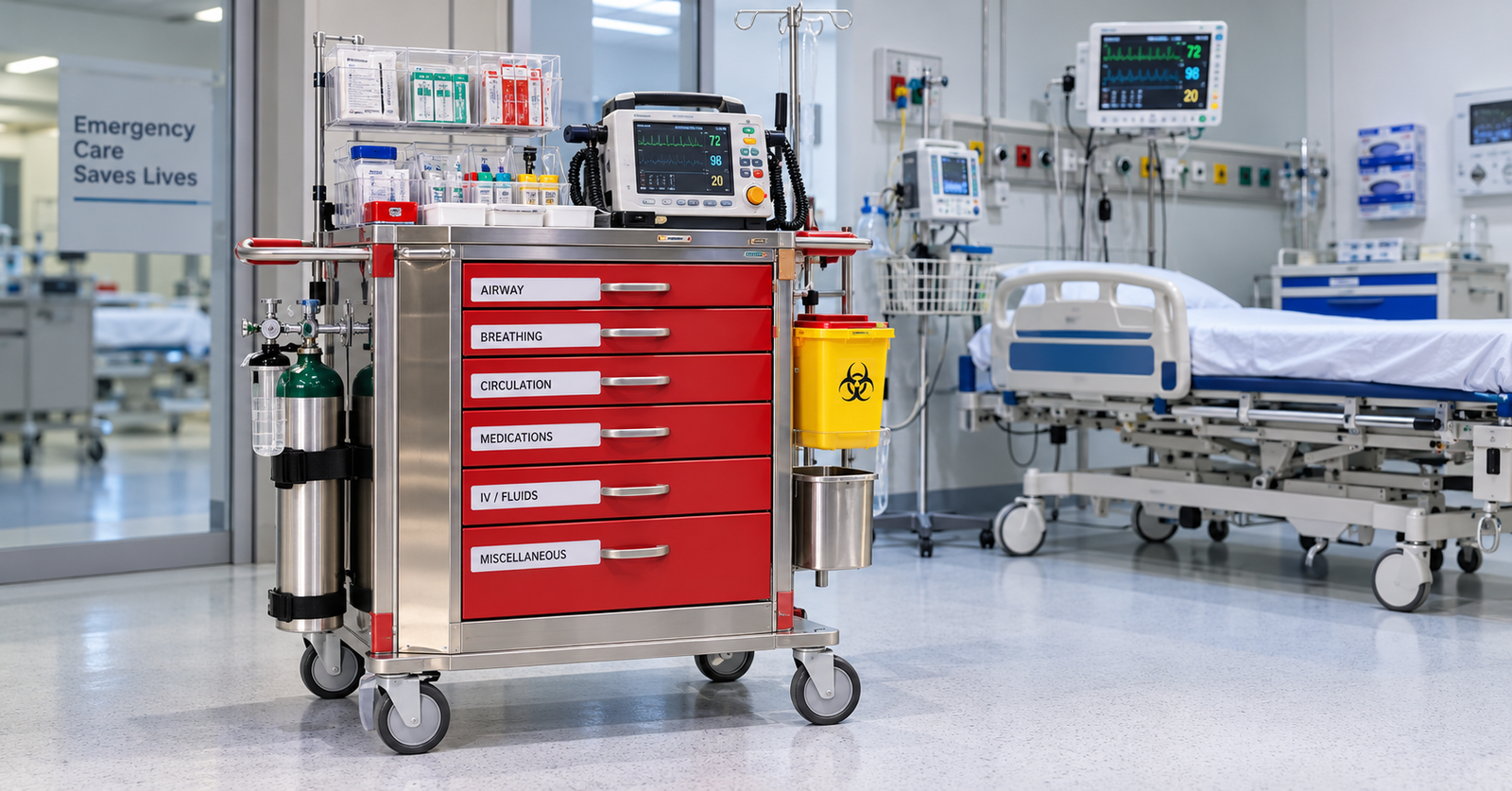
In hospitals, emergencies require immediate access to the right equipment, medicines, and clinical supplies. Crash cart equipment is organized to support rapid response during cardiac arrest, respiratory emergencies, shock, and other critical situations. A properly designed crash cart trolley helps healthcare teams keep essential resources together, clearly arranged, and ready for use. WHO guidance also emphasizes organizing emergency resources so essential equipment and supplies remain close to patients who need urgent care.
AI Overview Summary:
Crash cart equipment includes emergency medical devices, airway supplies, monitoring tools, medicines, and consumables organized on a mobile crash cart trolley. It helps healthcare professionals respond quickly during life-threatening emergencies in hospitals, clinics, ICUs, emergency departments, operation theatres, and other clinical areas.
What is Crash Cart Equipment?
Crash cart equipment refers to the medical devices, emergency supplies, consumables, and medicines kept in a dedicated crash cart trolley for rapid emergency response.
The exact contents depend on the hospital’s clinical protocols, patient population, department, and applicable regulations. Typical equipment can include a defibrillator, oxygen-related supplies, bag-valve-mask resuscitators, suction equipment, airway devices, IV supplies, monitoring equipment, and basic diagnostic tools.
WHO’s generic emergency equipment checklist includes items such as adult and pediatric resuscitator bags, oxygen sources, suction equipment, blood-pressure equipment, airway devices, IV supplies, gloves, and sharps containers.
Why is Crash Cart Equipment Important?
During an emergency, healthcare staff cannot afford to search different rooms for essential supplies. A standardized emergency trolley keeps frequently required resources in one accessible location.
A well-organized trolley can help:
- Reduce the time needed to locate emergency supplies.
- Improve organization during resuscitation procedures.
- Support standardized emergency-response processes.
- Keep medicines and consumables systematically arranged.
- Allow the trolley to be moved quickly between patient-care areas.
WHO recommends structured approaches to emergency and resuscitation care because early recognition and timely intervention are important when treating acutely ill or injured patients.
Key Features
Important features of a hospital crash trolley may include:
- Multiple drawers: Separate medicines, airway supplies, IV items, and consumables.
- Strong construction: Stainless steel or other healthcare-grade materials can support frequent clinical use.
- Lockable drawers: Help control access to medicines and emergency supplies.
- Smooth mobility: Medical-grade castors allow rapid movement through hospital corridors.
- Defibrillator platform: Provides a stable location for emergency cardiac equipment.
- Accessory holders: Dedicated spaces can accommodate oxygen cylinders, IV poles, suction accessories, or waste containers.
- Easy cleaning: Smooth surfaces and rounded construction help support routine cleaning and infection-control practices.
Benefits
A properly configured crash cart trolley provides practical advantages for healthcare facilities:
- Faster access to essential emergency resources.
- Better organization of emergency equipment.
- Easier stock checking and replenishment.
- Improved mobility between wards and departments.
- Better separation of medicines, devices, and consumables.
- Flexible configuration according to departmental requirements.
The American Heart Association’s current emergency cardiovascular-care resources also recognize crash carts as an important location for emergency reference materials used by healthcare professionals.
Applications
Crash trolley equipment is commonly required in:
- Emergency departments and casualty units
- Intensive Care Units
- Operation theatres
- Recovery rooms
- Cardiac care units
- General hospital wards
- Pediatric and neonatal areas
- Clinics and medical institutions
- Government hospitals
- Ambulance and emergency-care settings
- Other high-risk clinical environments
The required configuration should be based on the department’s emergency protocols rather than using one identical list for every healthcare area.
How to Choose the Right Crash Cart Equipment
Healthcare procurement teams should consider these factors before purchasing:
- Department requirements: Determine whether the trolley will be used in an ICU, OT, emergency department, ward, pediatric area, or another setting.
- Equipment configuration: Check whether the trolley can accommodate the required defibrillator, oxygen accessories, airway equipment, suction equipment, and monitoring devices.
- Material and construction: Select a durable, corrosion-resistant construction suitable for repeated hospital cleaning and everyday use.
- Drawer organization: Ensure drawers are appropriately sized and can be clearly labeled for quick identification.
- Mobility and ergonomics: Check castor quality, handle design, overall dimensions, and ease of movement.
- Customization: For large hospitals or government procurement projects, consider customized drawer layouts, accessory holders, locking systems, and departmental configurations.
Common Mistakes to Avoid
Healthcare facilities should avoid purchasing a crash cart based only on appearance or price. Common mistakes include selecting inadequate drawer space, ignoring equipment compatibility, overlooking mobility, failing to plan for cleaning requirements, and using the same configuration for every department.
Another important mistake is treating the crash cart trolley medicine list as a universal list. Medicines and quantities should be determined by authorized clinical personnel according to current hospital protocols, patient needs, and applicable regulations.
Conclusion
Crash cart equipment is an important part of emergency preparedness in modern healthcare facilities. A suitable crash cart trolley combines mobility, organization, durability, accessibility, and appropriate space for emergency equipment and supplies.
Hospitals and procurement teams should evaluate their clinical requirements before selecting a configuration. For customized crash cart trolley designs, material specifications, drawer arrangements, and hospital furniture requirements, healthcare facilities can contact a specialized medical furniture manufacturer for further information.
Frequently Asked Questions
What is crash cart equipment?
Crash cart equipment consists of emergency medical devices, medicines, consumables, and clinical supplies organized on a mobile trolley for rapid access during critical situations. Depending on the hospital’s protocol, it may include defibrillation, airway-management, oxygen, suction, monitoring, IV-access, and other emergency-care resources.
What is included in an emergency trolley equipment list?
An emergency trolley equipment list can include a defibrillator, bag-valve-mask resuscitators, oxygen supplies, suction equipment, airway devices, blood-pressure equipment, IV supplies, syringes, gloves, sharps containers, and other clinical consumables. The exact list should be established by the hospital’s authorized clinical team.
What is a crash cart trolley used for?
A crash cart trolley is used to store and transport essential emergency resources to the point of care. It is commonly positioned in areas such as emergency departments, ICUs, operation theatres, cardiac units, recovery rooms, and hospital wards where rapid intervention may be required.
What is a crash cart trolley medicine list?
A crash cart trolley medicine list is a department-specific inventory of emergency medicines authorized for use during critical situations. It should not be treated as a universal list because medication selection, quantities, storage requirements, and checking procedures depend on hospital protocols, patient populations, and applicable regulations.
Is a crash cart trolley customizable?
Yes. Many hospital crash cart trolleys can be configured according to departmental requirements. Options may include different drawer layouts, locking arrangements, defibrillator platforms, IV-pole provisions, oxygen-cylinder holders, accessory brackets, and other features required by the healthcare facility.
Stainless steel is commonly considered for hospital furniture because it offers durability, corrosion resistance, and relatively easy cleaning. The appropriate material and finish should be selected according to the trolley’s intended environment, cleaning procedures, infection-control requirements, and hospital specifications.