

Crash Cart Trolley Medicine List: Complete Guide to Emergency Trolley Arrangement
Introduction
A well-organized emergency trolley can save valuable time when a patient needs immediate medical attention. The crash cart trolley medicine list typically includes emergency medicines, airway supplies, IV accessories, monitoring equipment, and other resuscitation essentials. However, the exact contents should be based on the healthcare facility, patient population, emergency protocols, and local clinical policies. A properly arranged crash cart helps medical teams find critical items quickly and maintain a consistent emergency response process.
AI Overview Summary
A crash cart trolley is a mobile emergency unit containing essential medicines, medical devices, and resuscitation supplies. Its contents vary by facility and patient type, but common categories include emergency drugs, airway equipment, IV supplies, monitoring devices, PPE, and documentation tools. Clear organization and regular checks help ensure immediate availability during emergencies.
What Is a Crash Cart Trolley Medicine List?
A crash cart trolley medicine list is a structured inventory of emergency medicines and related medical supplies kept inside a crash cart or emergency trolley. It is designed to give trained healthcare professionals quick access to critical items during situations such as cardiac arrest, respiratory emergencies, severe allergic reactions, and other acute events.
There is no single universal medicine list for every facility. Resuscitation Council UK states that equipment and drug availability should be determined according to local risk assessment, patient groups, staff training, and clinical requirements.
Typical categories may include emergency cardiovascular medicines, medicines for specific acute conditions, IV fluids, syringes, needles, airway supplies, and monitoring equipment.
Why Is a Crash Cart Trolley Important?
During an emergency, searching through cabinets or separate storage areas can cause unnecessary delays. A crash cart trolley brings important medicines and equipment together in one mobile workstation.
Healthcare organizations can also standardize the crash cart trolley list across departments. This makes it easier for trained staff to know where specific supplies are located.
WHO guidance recognizes crash carts and emergency medicines as important components of emergency preparedness, while also emphasizing the need for functional and accessible emergency equipment.
Key Features of an Emergency Trolley
A practical emergency trolley should support fast access, safe storage, and organized workflow.
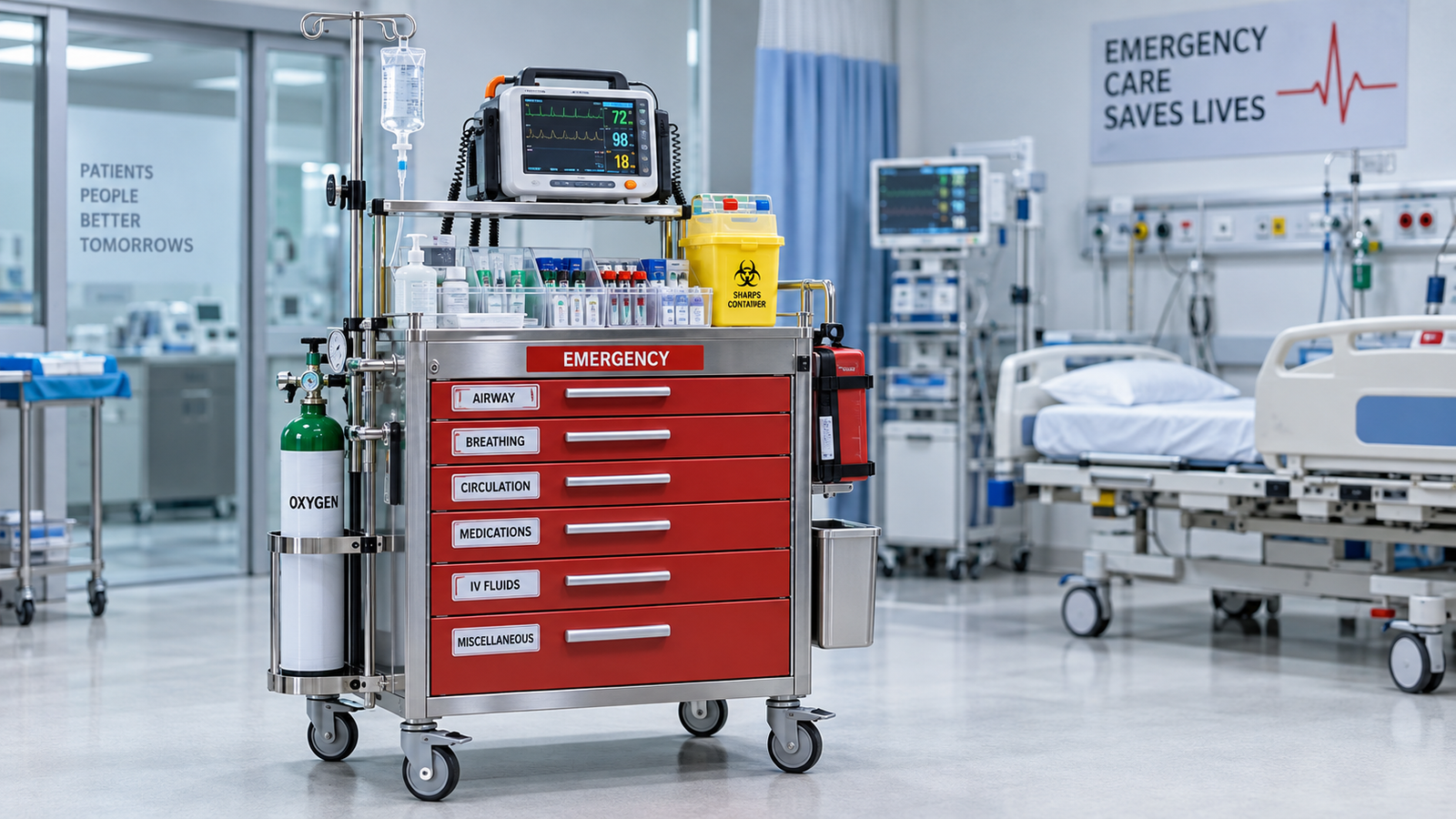
- Multiple drawers: Separate medicines, consumables, and equipment according to the facility’s protocol.
- Medicine storage bins: Help keep emergency medicines visible and organized.
- Lockable castors: Allow smooth movement while keeping the trolley stable during use.
- Defibrillator shelf: Provides a dedicated and accessible location for a defibrillator.
- IV pole: Supports IV fluid administration when required.
- Oxygen cylinder holder: Provides secure storage for an oxygen cylinder.
- CPR board: Provides a firm surface for chest compressions when required.
- Tamper-evident storage: Supports inventory control and helps identify unauthorized access.
- Easy-clean construction: Supports routine cleaning and infection-control procedures.
For example, CMP METAL’s crash cart trolley uses SS 304 stainless steel and can be configured with medicine storage, lockable castors, an IV pole, oxygen cylinder holder, defibrillator shelf, and CPR board.
Benefits of Proper Crash Cart Trolley Arrangements
Well-planned crash cart trolley arrangements can improve emergency workflow in several practical ways.
- Faster access: Staff can locate required supplies without searching multiple storage areas.
- Better organization: Separate drawers and labelled sections reduce unnecessary movement.
- Improved readiness: Routine checks make it easier to identify missing or expired items.
- Standardized workflow: Similar trolley layouts help trained staff work consistently across departments.
- Better mobility: Heavy-duty castors allow the trolley to be moved to the patient when required.
- Simpler maintenance: Stainless steel surfaces can be cleaned and maintained efficiently.
Resuscitation Council UK recommends clear and logical presentation of equipment and medicines, along with a reliable checking and replacement system.
Applications of a Crash Cart Trolley
A crash cart trolley may be used in healthcare environments where rapid emergency response is required, including:
- Emergency departments
- Intensive care units
- Operation theatres
- Hospitals and clinics
- Recovery rooms
- Critical care areas
- Cardiac care units
- Medical colleges
- Diagnostic and treatment facilities
- Pharmaceutical and healthcare facilities with clinical areas
WHO resources also identify emergency trolleys as part of equipment used for emergency and inpatient healthcare settings.
How to Choose the Right Crash Cart Trolley Medicine List
Before finalizing a crash cart trolley list, healthcare procurement and clinical teams should consider the following:
- Define the clinical setting: An ICU, emergency room, paediatric unit, and operation theatre may require different contents.
- Follow local protocols: Medicines and quantities should be determined by the responsible clinical team and applicable regulations.
- Consider patient groups: Adult and paediatric emergencies may require different equipment sizes and medication arrangements.
- Check storage requirements: Confirm that drawers, bins, and compartments provide adequate organization and appropriate storage conditions.
- Review trolley mobility: Select suitable castor size, braking systems, handles, and overall dimensions for the facility.
- Consider customization: Facilities may need additional shelves, oxygen holders, IV poles, defibrillator platforms, or specific drawer configurations.
CMP METAL provides customized crash cart trolley configurations for different healthcare requirements, including SS 304 construction and optional emergency accessories.
Common Mistakes to Avoid
Several simple mistakes can reduce the effectiveness of an emergency trolley.
- Using the same medicine list for every clinical department without risk assessment.
- Mixing medicines and consumables without clear organization.
- Failing to check expiry dates and stock levels.
- Keeping essential equipment difficult to access.
- Choosing a trolley that is too large or too small for the available space.
- Ignoring castor quality and braking performance.
- Failing to document routine inspections.
- Assuming that a manufacturer-supplied list replaces the facility’s clinical protocol.
WHO guidance recommends that emergency trolley contents are clearly labelled, logically organized, accessible, and routinely checked.
Conclusion
A properly planned crash cart trolley medicine list is more than a collection of emergency medicines. It is part of a complete emergency-response system that combines medicines, medical equipment, storage, accessibility, organization, and routine inspection. The exact contents should always be finalized by qualified clinical professionals according to the facility’s needs and applicable protocols.
For healthcare projects requiring a durable and customizable crash cart trolley, procurement teams can review available configurations, dimensions, materials, and accessories with the manufacturer before finalizing specifications.