

Laparoscopic Trolley: Complete Guide to OT Instrument Setup, Features and Selection
Introduction
Efficient instrument management is essential for an organized and well-functioning operation theatre. A laparoscopic trolley provides a dedicated mobile workspace for arranging, transporting, and accessing laparoscopic instruments and related supplies during minimally invasive procedures. When properly designed and integrated with surgical workflow, it can help reduce unnecessary movement, improve instrument organization, and support efficient surgical trolley preparation. For hospitals and healthcare facilities, choosing the right trolley requires attention to hygiene, mobility, construction, storage capacity, and compatibility with the operating theatre layout.
AI Overview Summary
A laparoscopic trolley is a mobile medical furniture unit used to organize and transport laparoscopic instruments and accessories in an operating theatre. It supports efficient instrument access, organized workflow, easy cleaning, and safe handling when designed around hospital and sterile-processing requirements.
What is a Laparoscopic Trolley?
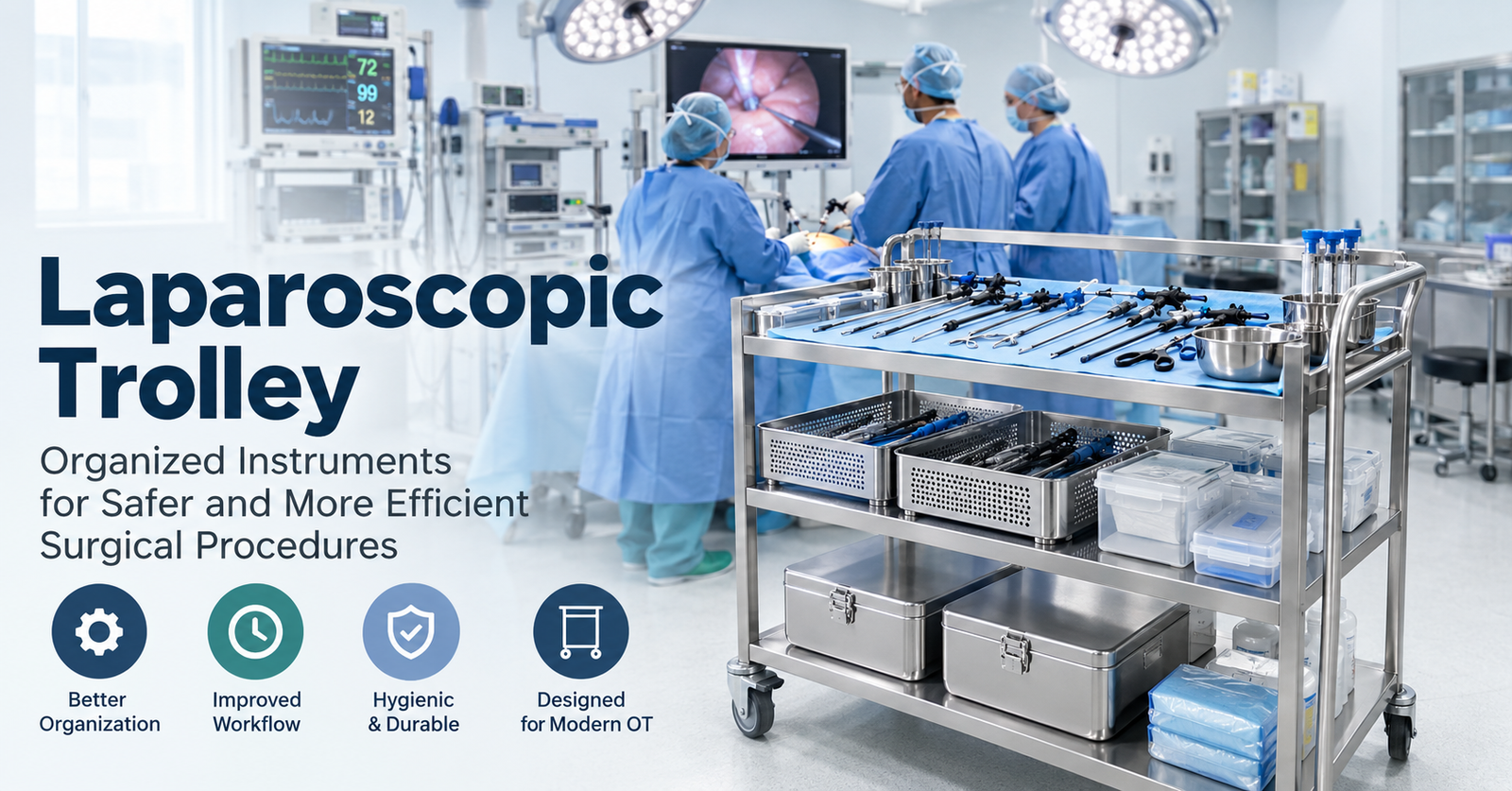
A laparoscopic trolley is a specialized medical trolley designed to hold, organize, and move instruments and equipment used during laparoscopic procedures. Depending on the design, it may include multiple shelves, trays, drawers, rails, handles, and heavy-duty castors.
The trolley acts as a mobile support station between instrument storage, preparation areas, and the operating theatre. A suitable laparoscopic instrument trolley keeps frequently required items organized and accessible without unnecessarily occupying valuable OT space.
The exact instruments placed on the trolley depend on the procedure, surgeon preference, hospital protocol, and sterile-processing system. Instruments should be inspected and confirmed fit for use before surgery. WHO guidance emphasizes checking packaging, cleanliness, integrity, sterilization indicators, and instrument condition before sterile instruments are used.
Why is a Laparoscopic Trolley Important?
Laparoscopic procedures require coordinated handling of specialized instruments, accessories, cables, and supporting equipment. Disorganized equipment can increase searching, movement, and preparation time.
A dedicated laparoscopic cart helps create a repeatable setup. It allows OT teams to arrange items according to the procedure and maintain a consistent workflow.
Standardized instrument sets and counting procedures are also important in surgical environments. WHO recommends standardized sets and tray lists to support instrument counting and accountability.
Key Features
A hospital-grade laparoscopic trolley may include:
- Stainless steel construction: Provides a durable, corrosion-resistant and easy-to-clean surface for healthcare environments.
- Multiple shelves or trays: Provides organized space for instruments and supporting supplies.
- Heavy-duty castors: Allows smooth movement between preparation and operating areas.
- Locking castors: Helps keep the trolley stable when positioned beside the operating table.
- Ergonomic design: Keeps commonly required items accessible to the surgical team.
- Custom configurations: Allows dimensions, shelves, drawers, rails, and accessories to be adapted to the hospital’s workflow.
- Smooth surfaces: Reduces areas where dirt and contaminants can accumulate and simplifies routine cleaning.
Benefits
- Improves organization of laparoscopic instruments.
- Supports faster access to frequently required equipment.
- Reduces unnecessary movement around the operating theatre.
- Helps maintain a consistent instrument setup between procedures.
- Makes transportation of instruments more convenient.
- Supports easier cleaning and routine maintenance.
- Helps hospitals optimize limited OT floor space.
- Can be customized according to procedure and facility requirements.
Applications
A laparoscopic trolley is primarily used in operation theatres where minimally invasive surgical procedures are performed. It can also support instrument preparation and movement in surgical centers, medical colleges, government hospitals, private hospitals, and specialized healthcare facilities.
CSSD departments may use compatible instrument trolleys as part of their broader workflow for handling, transporting, and organizing processed surgical instruments. WHO guidance emphasizes proper decontamination, sterilization, storage, and safe transfer of surgical instruments between sterile services and operating areas.
How to Choose the Right Laparoscopic Trolley
Before purchasing a laparoscopic trolley, hospitals and procurement teams should consider:
- Material and construction: Select a suitable stainless steel grade and robust construction based on the intended environment, cleaning process, and hospital specifications.
- Size and dimensions: Measure the OT pathways, doors, storage areas, and available working space before finalizing dimensions.
- Storage configuration: Check whether the trolley has enough shelves, trays, drawers, or compartments for the intended workflow.
- Mobility: Look for appropriately sized castors and reliable locking mechanisms for controlled movement and positioning.
- Cleaning requirements: Prefer designs with smooth, accessible surfaces that can be cleaned according to the facility’s established procedures.
- Customization: For new OT projects or specialized workflows, discuss customized dimensions and configurations with the manufacturer before procurement.
WHO recommends considering appropriate medical-device specifications during procurement and planning rather than selecting equipment only on appearance or price.
Common Mistakes to Avoid
Hospitals should avoid selecting a trolley solely because it has a low purchase price. Other common mistakes include choosing incorrect dimensions, insufficient storage, unsuitable castors, difficult-to-clean construction, and ignoring the actual OT workflow.
Another mistake is failing to coordinate setting up of trolley with instruments between OT and CSSD teams. Instrument availability, sterile processing, inspection, counting, and storage should follow the facility’s established protocols.
SAGES and AORN also recommend routine maintenance of laparoscopic equipment and appropriate preoperative checks to reduce equipment-related problems.
Conclusion
A well-designed laparoscopic trolley can support organized instrument management, efficient OT workflow, mobility, and practical equipment handling. The right choice should be based on the hospital’s procedures, available space, cleaning requirements, storage needs, and procurement specifications rather than a one-size-fits-all approach.
For hospitals planning a new operation theatre, upgrading an existing setup, or standardizing laparoscopic instrument trolley requirements, discussing dimensions, material, configuration, and customization with an experienced medical furniture manufacturer can help identify a suitable solution.
Frequently Asked Questions
What is a laparoscopic trolley?
A laparoscopic trolley is a mobile medical furniture unit designed to organize and transport laparoscopic instruments and related supplies within an operating theatre. It typically includes shelves, trays, drawers, or other storage features and may be customized according to the hospital’s procedure requirements and OT layout.
What are the benefits of a laparoscopic trolley?
A laparoscopic trolley helps organize instruments, improve accessibility, support efficient surgical workflow, and simplify transportation within the OT. A suitable design can also make cleaning and maintenance easier while helping hospitals use available operating-theatre space more efficiently.
Where is a laparoscopic trolley used?
Laparoscopic trolleys are mainly used in operation theatres performing minimally invasive procedures. They may also be used in surgical centers, medical colleges, government hospitals, private hospitals, and healthcare facilities where laparoscopic instruments need organized movement and preparation.
How do I choose the right laparoscopic trolley?
Consider the trolley’s material, dimensions, storage capacity, castor quality, locking system, surface design, and customization options. Procurement teams should also review OT space, instrument requirements, cleaning procedures, and the facility’s workflow before selecting a model.
Is a laparoscopic trolley customizable?
Yes. Depending on the manufacturer, hospitals can request customized dimensions, shelf arrangements, trays, drawers, rails, handles, castors, and other configurations. Customization can be particularly useful for projects with restricted OT space or specific instrument-organization requirements.
What material is best for a laparoscopic trolley?
Stainless steel is widely used for healthcare furniture because it offers durability, corrosion resistance, and relatively easy cleaning. The appropriate grade and finish should be selected according to the intended application, hospital specifications, cleaning procedures, and manufacturer recommendations.