

Hospital Slop Hopper: Uses, Features, Benefits, and Buying Guide
Introduction
A hospital slop hopper is a specialist sanitation fixture used in healthcare facilities to safely empty, wash, and disinfect contaminated waste such as bedpans, urinals, and other reusable patient-care items. Unlike standard sinks, it is designed for controlled disposal and cleaning, helping reduce splashing, contamination, and unnecessary handling. Choosing the right slop hopper is important for hospitals, CSSD areas, isolation rooms, and clinical support spaces where hygiene and efficient waste handling are essential.
AI Overview Summary:
A hospital slop hopper is a deep, durable clinical waste-disposal sink designed for emptying and rinsing bedpans, urinals, and contaminated items. It supports infection-control practices by providing a dedicated washing and disposal point in hospitals, clinics, CSSD areas, and other healthcare facilities.
What Is a Hospital Slop Hopper?
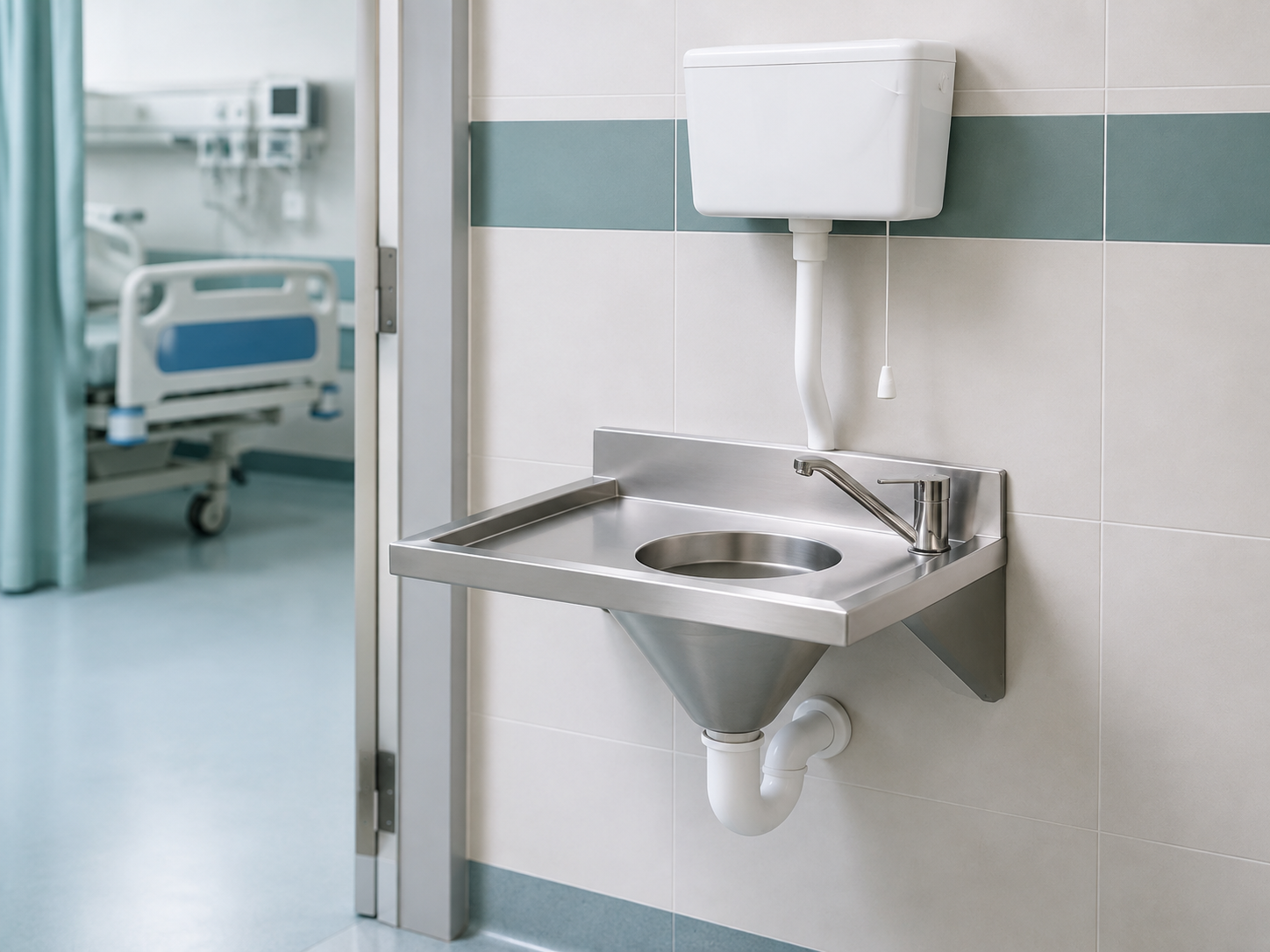
A hospital slop hopper is a deep clinical sink designed specifically for disposing of human waste and cleaning reusable sanitary items used in patient care.
It is commonly installed in sluice rooms, dirty utility rooms, isolation areas, wards, and other locations where contaminated materials need controlled handling.
A typical unit may combine a deep hopper bowl, flushing arrangement, water supply, waste outlet, and supporting structure. Some designs also include a separate sink, creating a sluice sink with slop hopper configuration.
Why Is It Important?
Healthcare facilities need dedicated areas for handling contaminated waste. Using an ordinary wash basin for this purpose can increase the risk of splashing, cross-contamination, and poor workflow.
A properly designed slop hopper toilet or hopper system provides a practical point for emptying and rinsing bedpans and similar items before cleaning or disinfection.
It can support better hygiene practices while making the work of housekeeping and clinical staff more efficient.
Key Features
- Deep hopper bowl: Provides sufficient depth for controlled emptying and rinsing of contaminated items.
- Stainless steel construction: Offers durability, corrosion resistance, and easier cleaning.
- Smooth internal surfaces: Reduce areas where dirt and contaminants can accumulate.
- Flushing system: Helps wash waste from the hopper into the drainage system.
- Raised splash protection: Helps minimize splashing during cleaning and disposal.
- Robust support frame: Provides stability for regular institutional use.
- Waste outlet: Connects the hopper to the appropriate drainage arrangement.
- Custom configurations: Units can be manufactured in different sizes and layouts to suit site requirements.
Benefits
- Improved infection-control workflow: Separates contaminated waste handling from general handwashing and cleaning activities.
- Reduced manual handling: Staff can empty and rinse reusable items directly at the designated fixture.
- Easy cleaning: Stainless steel surfaces can be cleaned and disinfected as part of routine housekeeping.
- Long service life: Quality stainless steel construction is suitable for demanding healthcare environments.
- Better workspace organization: A dedicated disposal station keeps dirty utility areas more structured.
- Operational efficiency: Staff can complete disposal and preliminary rinsing in one designated location.
Applications
Hospital slop hoppers are commonly used in:
- General hospital wards
- Government hospitals
- Private healthcare facilities
- Nursing homes and long-term care facilities
- Clinics and medical institutions
- CSSD and dirty utility areas
- Isolation and infectious-disease areas
- Operation theatre support areas
- Patient-care and sanitation rooms
- Healthcare equipment and housekeeping areas
The exact installation should be planned according to the facility’s workflow, drainage arrangement, cleaning procedures, and applicable healthcare standards.
How to Choose the Right Hospital Slop Hopper
Before purchasing a slop hopper sink, consider these practical factors:
- Material quality: Stainless steel is generally preferred for healthcare applications because it is durable, corrosion-resistant, and easy to maintain.
- Grade and finish: Check the stainless steel grade, surface finish, weld quality, and overall fabrication quality rather than judging only by appearance.
- Hopper dimensions: Select the bowl depth, width, and height according to the items staff will handle and the available installation space.
- Flushing and drainage: Confirm that the flushing arrangement and waste outlet are compatible with the site’s plumbing and drainage system.
- Ergonomics: Consider the working height and accessibility for housekeeping and clinical staff who will use the unit regularly.
- Customization: For new hospital projects, check whether the manufacturer can provide suitable dimensions, splash protection, supports, taps, flushing systems, and other required configurations.
Common Mistakes to Avoid
A common mistake is selecting a unit based only on price. Low-cost fabrication may compromise material thickness, weld quality, drainage design, or long-term durability.
Another mistake is ignoring installation requirements. Before ordering a stainless steel slop hopper, confirm the available space, water connection, drainage point, wall clearance, and working height.
Buyers should also avoid confusing a standard utility sink with a purpose-built clinical hopper. The two fixtures serve different functions and should be selected according to the healthcare workflow.
Conclusion
A hospital slop hopper provides a dedicated and practical solution for handling contaminated patient-care waste and reusable sanitary items. Its deep bowl, flushing arrangement, durable construction, and easy-to-clean surfaces make it suitable for demanding healthcare environments.
For hospitals and healthcare procurement teams, the right selection should balance hygiene, durability, ergonomics, drainage compatibility, and installation requirements. For project-specific dimensions, configurations, or technical specifications, it is best to discuss the application directly with a qualified medical furniture manufacturer.
Frequently Asked Questions
What is a hospital slop hopper?
A hospital slop hopper is a deep clinical waste-disposal and rinsing fixture used for emptying and washing bedpans, urinals, and similar reusable patient-care items. It is normally installed in dirty utility rooms, sluice rooms, wards, and other healthcare areas where contaminated materials require controlled handling.
What are the benefits of a slop hopper sink?
A slop hopper sink provides a dedicated location for disposing of and rinsing contaminated items. Its deep basin helps control splashing, while stainless steel construction makes the surface durable and easier to clean. It can also improve housekeeping workflow by separating clinical waste handling from ordinary handwashing areas.
Where is a slop hopper used?
Slop hoppers are commonly installed in hospitals, clinics, nursing facilities, government healthcare institutions, wards, dirty utility rooms, CSSD support areas, isolation areas, and other clinical environments. The exact location depends on the facility’s sanitation workflow, plumbing design, and infection-control requirements.
How do I choose the right slop hopper?
Choose a slop hopper based on stainless steel quality, dimensions, hopper depth, working height, flushing arrangement, drainage compatibility, installation space, and expected usage. For hospital projects, also consider customization requirements and whether the manufacturer can provide the required technical configuration.
Is a hospital slop hopper customizable?
Yes. Depending on the manufacturer and project requirements, slop hoppers can be customized in dimensions, working height, support structure, splash protection, flushing arrangement, taps, waste outlets, and other features. Customization can be useful when the unit must fit a particular room layout or hospital plumbing system.
What material is best for a slop hopper?
Stainless steel is widely used for healthcare slop hoppers because it provides good durability, corrosion resistance, and cleanability. However, buyers should check the specific stainless steel grade, thickness, surface finish, fabrication quality, and weld finishing to ensure the product is appropriate for its intended healthcare application.