

Pass Box Types: A Complete Guide for Hospitals, Cleanrooms and Pharma Facilities
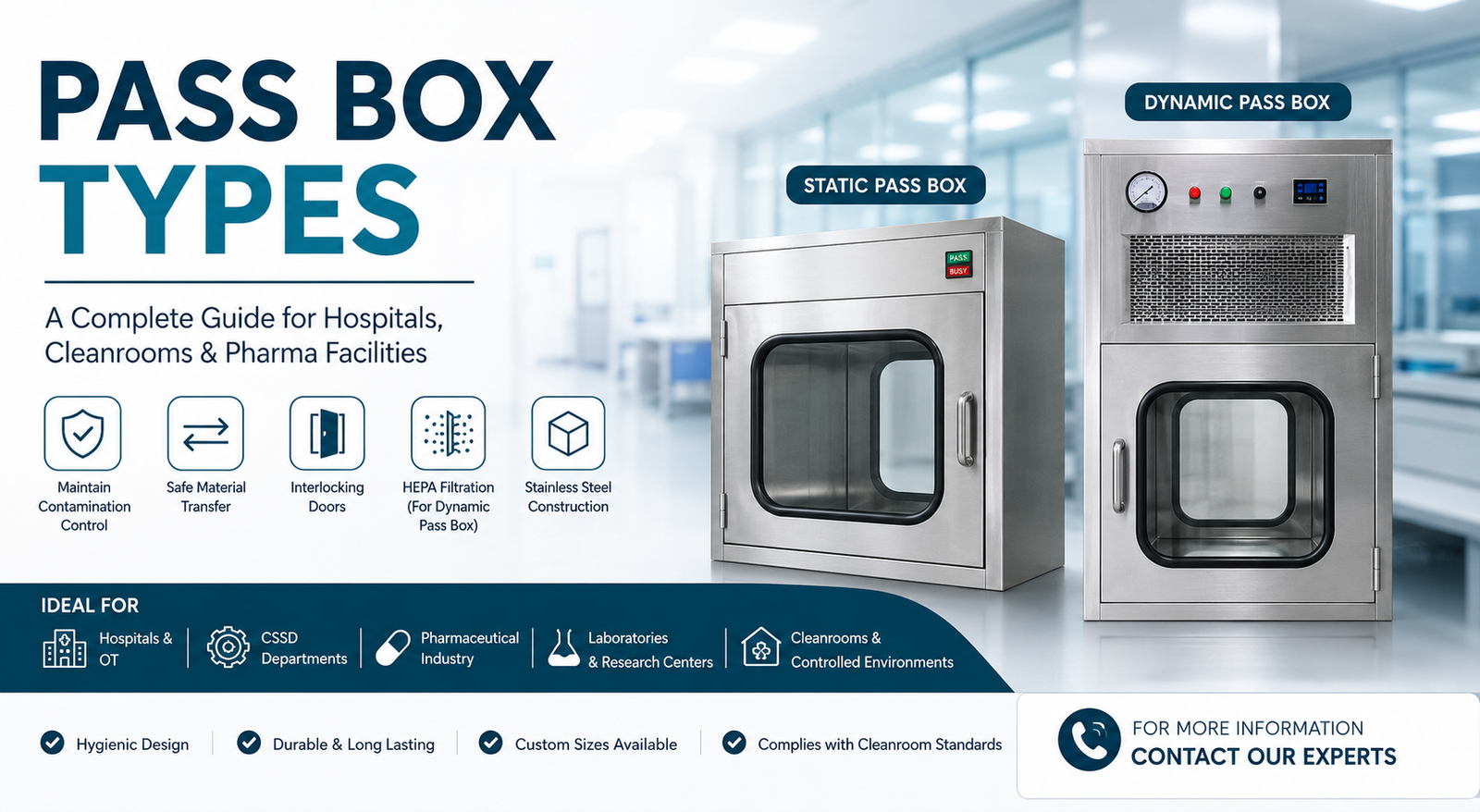
Introduction
Material transfer is a critical part of maintaining hygiene and contamination control in hospitals, pharmaceutical plants, laboratories, and cleanrooms. Pass box types are designed to move materials between controlled areas without unnecessary personnel movement. Choosing the right passbox for clean room applications can improve workflow, reduce contamination risks, and support better environmental control. From static and dynamic models to stainless steel configurations, understanding the available options helps hospitals, pharma companies, and cleanroom professionals select equipment that matches their operational requirements.
AI Overview Summary:
Pass box types are enclosed transfer units used to move materials between clean or controlled areas while reducing unnecessary door opening and personnel movement. Common options include Static Pass Box and Dynamic Pass Box, with features such as interlocking doors, stainless steel construction, viewing windows, and optional HEPA filtration.
What are Pass Box Types?
A pass box is an enclosed chamber installed between two areas to transfer materials while helping maintain separation between environments. It is commonly used in hospitals, CSSD departments, pharmaceutical manufacturing, laboratories, and controlled cleanrooms.
The two main pass box types are Static Pass Box and Dynamic Pass Box. A static model transfers materials without active air filtration, while a dynamic model can use HEPA filtration to support controlled airflow.
Why is a Pass Box Important?
A pass box helps reduce unnecessary movement between clean and less-controlled areas. Instead of opening a main cleanroom door repeatedly, staff can transfer supplies through a dedicated chamber.
This can support:
- Better contamination control
- Reduced personnel movement
- Improved workflow efficiency
- Easier separation of clean and non-clean areas
- More organized material transfer
For laboratories and pharmaceutical facilities, pass boxes should be selected according to the facility’s process, cleanliness requirements, and risk assessment.
Key Features
- Interlocking Doors: Prevent both doors from being opened simultaneously.
- Stainless Steel Construction: SS 304 or SS 316 provides durability and supports easy cleaning.
- Viewing Window: Allows staff to check materials before opening the unit.
- Smooth Internal Surfaces: Help simplify routine cleaning and maintenance.
- HEPA Filtration: Available in dynamic configurations where controlled air filtration is required.
- Custom Dimensions: Sizes can be selected according to wall openings, material size, and workflow.
Benefits of Using a Pass Box
- Improved Material Transfer: Creates a dedicated route between controlled spaces.
- Better Workflow: Reduces the need for staff to move repeatedly between areas.
- Reduced Door Opening: Helps maintain separation between adjoining environments.
- Easy Maintenance: Stainless steel surfaces are practical for frequent cleaning.
- Flexible Installation: Units can be designed for different wall layouts and project requirements.
Applications of Pass Boxes
A lab pass box can be useful in research and diagnostic laboratories where controlled material movement is important. In hospitals, a Hospital Pass Box may be installed near CSSD, sterile processing, operation theatre, or other controlled areas.
Other applications include:
- Pharmaceutical manufacturing and Pharma Pass Box installations
- Medical device manufacturing
- Biotechnology laboratories
- Cleanrooms and controlled environments
- Pathology and research laboratories
- Food and electronics manufacturing areas
Pass boxes can also support organized workflows around sterile supplies and surgical trolley preparation areas when material transfer between controlled spaces is required.
How to Choose the Right Pass Box Types
Before purchasing from a Pass Box Manufacturer or Pass Box Supplier, consider these factors:
- Static or Dynamic: Choose static transfer when active filtration is unnecessary; consider dynamic models when filtered airflow is part of the process requirement.
- Material: SS 304 is commonly suitable, while SS 316 may be considered for more demanding environments.
- Door Interlocking: Confirm whether mechanical or electromagnetic interlocking matches your operating requirements.
- Size: Select dimensions based on the largest materials that need to pass through the chamber.
- Cleanroom Requirements: Consider the required cleanliness level, airflow arrangement, cleaning procedure, and validation needs.
- Customization: Check whether the supplier can provide suitable dimensions, viewing windows, HEPA filtration, alarms, or other project-specific features.
Common Mistakes to Avoid
Avoid selecting a passbox based only on price or external dimensions. Buyers should also check internal working space, material grade, door interlocking, filtration requirements, installation conditions, and cleaning procedures.
Another common mistake is assuming every cleanroom requires a Dynamic Pass Box. The correct choice depends on the process and environmental requirements of the facility.
Conclusion
Understanding different pass box types makes it easier to select a transfer system that supports hygiene, workflow, and controlled-environment requirements. Static and dynamic models serve different purposes, while stainless steel construction, interlocking doors, viewing windows, and optional filtration can improve practical usability.
Hospitals, pharmaceutical facilities, laboratories, and cleanroom project teams should evaluate their actual process requirements before choosing a Pass Box for Clean Room applications. For customized dimensions and specifications, discuss your project requirements with an experienced manufacturer.
Frequently Asked Questions
What is a pass box?
A pass box is an enclosed transfer chamber used to move materials between two adjoining areas while limiting unnecessary personnel movement and door opening. It is commonly installed in hospitals, pharmaceutical facilities, laboratories, CSSD departments, and cleanrooms where controlled material transfer is required.
What are the main pass box types?
The main types are Static Pass Box and Dynamic Pass Box. A static unit is designed for material transfer without active air filtration, while a dynamic model can incorporate HEPA filtration and controlled airflow. The appropriate type depends on the facility’s process and cleanliness requirements.
Where is a pass box used?
Pass boxes are used in hospitals, operation theatres, CSSD departments, pharmaceutical manufacturing plants, laboratories, biotechnology facilities, medical device manufacturing units, and other controlled environments. They provide a dedicated route for transferring instruments, supplies, samples, and other materials between separated areas.
What material is best for a pass box?
Stainless steel is widely used because it provides strength, corrosion resistance, and a surface that can be cleaned regularly. SS 304 is a common choice for healthcare and cleanroom applications, while SS 316 may be considered when greater resistance to aggressive environments is required.
Can a pass box be customized?
Yes. Depending on the manufacturer, pass boxes can be customized for dimensions, material grade, door configuration, interlocking system, viewing windows, filtration, alarms, and other project requirements. Customization is particularly useful when the unit must match an existing cleanroom wall opening or material-transfer workflow.
What is the difference between static and dynamic pass boxes?
A Static Pass Box transfers materials without an active filtered-air system. A Dynamic Pass Box incorporates an airflow and filtration arrangement, commonly including HEPA filtration, to provide greater control during material transfer. Selection should be based on the facility’s contamination-control strategy and process requirements.