Introduction
Patient transportation is an important part of hospital and diagnostic imaging operations. Patients often need assistance moving between hospital wards, preparation rooms, and MRI examination areas. Choosing suitable transport equipment helps healthcare staff manage these movements while considering patient comfort and safety.
A Non Magnetic MRI Trolley is designed for patient transportation in specified MRI environments. Before selecting one, healthcare facilities should evaluate equipment compatibility, patient support, manoeuvrability, and the requirements of their MRI department.
What Is MRI Patient Transport Equipment?
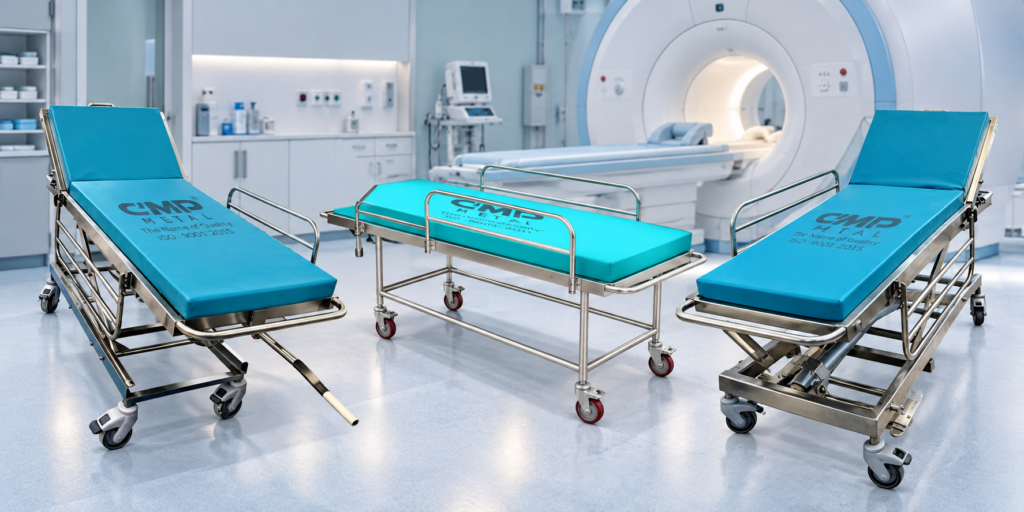
MRI patient transport equipment helps healthcare staff move patients between designated clinical areas. Depending on the design, a trolley may include a padded mattress, adjustable backrest, side rails, transport handles, and braking mechanisms.
Equipment intended for MRI environments requires special consideration because MRI scanners generate strong magnetic fields. Its suitability depends on the complete assembly, including the frame, wheels, fasteners, brakes, and accessories.
Hospitals should review technical documentation and confirm the permitted operating conditions before allowing equipment into a restricted MRI area.
Why Is MRI Compatibility Important?
MRI scanners use powerful magnetic fields to create detailed images of internal body structures. Ferromagnetic objects can be attracted towards the scanner, creating serious safety risks.
Standard hospital trolleys may contain unsuitable components even when their main frames appear appropriate. This is why hospitals must assess the complete product rather than relying only on its material description.
Properly selected transport equipment supports organised patient movement and helps healthcare staff follow established MRI safety procedures.
Key Features to Consider
Suitable Construction
The complete trolley should be evaluated for its intended magnetic field conditions. Buyers should review the frame, wheels, bearings, fasteners, braking system, and accessories.
Patient Comfort
A suitable mattress and appropriate support dimensions help patients remain comfortable during transportation. An adjustable backrest may be useful for patients who cannot comfortably lie flat.
Stability and Mobility
A stable frame, suitable wheels, and reliable brakes support controlled movement. The trolley should also fit the hospital’s corridors, doorways, and patient transfer areas.
Easy Maintenance
Durable surfaces and accessible components can simplify routine cleaning. Clear maintenance instructions help staff identify wear, damage, and replacement requirements.
Appropriate Load Capacity
The trolley must support the expected patient weight within its rated safe working load. Buyers should confirm this specification before ordering.
Benefits for Hospitals and Diagnostic Imaging Centres
Selecting appropriate patient transport equipment can offer several practical advantages:
- Improved patient handling: Supports patients who need assistance moving between departments.
- Better workflow: Helps coordinate transfers between hospital wards and imaging areas.
- Patient comfort: Suitable mattresses and positioning features accommodate different patient needs.
- Controlled movement: Appropriate wheels and brakes support stable transportation.
- Simplified maintenance: Clear instructions help staff perform routine inspections.
- Informed purchasing: Technical specifications allow procurement teams to compare available models.
These benefits depend on the product design, patient requirements, staff training, and the facility’s safety procedures.
Applications in Healthcare Facilities
Patient transport equipment may be required in hospital radiology departments, private imaging centres, medical colleges, specialist diagnostic facilities, and new hospital construction projects.
An MRI Compatible Patient Trolley may be considered for patient transfers in designated MRI-related areas. However, its suitability for entry into the scanner room must be confirmed against the equipment’s documented classification and the facility’s safety requirements.
How to Choose the Right Equipment
Hospital procurement managers and healthcare equipment distributors should consider these factors before purchasing:
- Verify compatibility: Request documentation specifying the intended MRI conditions and any restrictions.
- Review construction: Check all components, including wheels, fasteners, bearings, and brakes.
- Assess patient requirements: Compare load capacity, mattress dimensions, and available support features.
- Check manoeuvrability: Confirm that the equipment suits the facility’s corridors, doorways, and transfer spaces.
- Review maintenance: Understand cleaning requirements, replacement parts, warranty coverage, and inspection procedures.
- Compare documentation: Request technical drawings, specifications, and relevant testing or compliance records.
A Non Magnetic MRI Trolley Manufacturer should be able to provide clear product specifications and relevant documentation for the proposed configuration. Buyers should independently verify that the supplied equipment is suitable for their intended environment.
For international procurement in the USA, Japan, and Europe, facilities should also check applicable local regulations and purchasing requirements.
Common Mistakes to Avoid
One common mistake is assuming that stainless steel or aluminium construction automatically makes a trolley suitable for every MRI environment. The complete assembly must be evaluated for its intended conditions of use.
Buyers should also avoid overlooking load limits, braking performance, dimensions, maintenance requirements, or compatibility documentation. Unverified modifications can affect the suitability of the finished equipment.
An MRI Safe Trolley should not be selected based on its name alone. Hospitals should review the supporting documentation and obtain confirmation from designated MRI safety personnel before allowing it into a restricted area.
Conclusion
Selecting suitable patient transport equipment involves more than comparing prices or construction materials. Healthcare facilities should consider patient comfort, handling, maintenance, technical documentation, and the magnetic field conditions in which the equipment will operate.
A careful purchasing process helps hospitals and diagnostic centres identify equipment that meets their operational needs while supporting established MRI safety procedures.
Frequently Asked Questions
1. Why do MRI departments need specialised transport equipment?
MRI departments operate around strong magnetic fields that can create hazards when unsuitable equipment enters restricted areas. Specialised transport equipment is evaluated for specified conditions, helping healthcare teams manage patient transfers while following established safety procedures.
2. Can a standard hospital trolley enter an MRI room?
Not unless its suitability for the intended environment has been verified. Standard trolleys may contain ferromagnetic components that pose risks near a scanner. Staff should follow the facility’s screening procedures and obtain the required approval before moving equipment into a restricted MRI area.
3. Which materials can be used in MRI environments?
Certain aluminium alloys, polymers, and other appropriately selected materials may be suitable for specific applications. However, the frame material alone does not establish MRI compatibility. The complete assembly, including wheels, fasteners, bearings, brakes, and accessories, must be evaluated.
4. What should buyers check before ordering?
Buyers should review technical specifications, permitted operating conditions, load capacity, dimensions, patient support features, cleaning instructions, warranty terms, and maintenance requirements. They should also request relevant compatibility documentation for the exact model and configuration being supplied.
5. Can patient transport equipment be customised?
Some designs may offer options for dimensions, mattresses, backrests, side rails, and other accessories. Any modification should be assessed because it may affect the equipment’s suitability for MRI use. Buyers should obtain written confirmation before accepting a customised configuration.
6. How often should transport equipment be inspected?
Inspection frequency should follow the manufacturer’s instructions and the hospital’s maintenance policy. Staff should check the frame, wheels, brakes, mattress, and other components for damage or wear. Defective equipment should be removed from service until it has been appropriately assessed.
7. What should international hospital buyers consider?
International buyers should check technical documentation, compatibility, load capacity, maintenance support, warranty terms, and applicable local regulations. Requirements may vary between markets and healthcare facilities, so buyers should verify the documentation and purchasing conditions before placing an order.