Introduction
Emergency situations in hospitals require quick decisions, immediate access to essential medicines, and well-organized medical equipment. A crash cart trolley helps healthcare professionals keep emergency supplies ready when every second matters. Choosing the right Crash Cart Trolley Manufacturer in India is important for hospitals that need durable construction, practical storage, and easy movement during critical situations. Whether you manage an ICU, emergency department, or operation theatre, selecting a suitable trolley can support better organization and help medical teams respond efficiently.
AI Overview Summary: A crash cart trolley is a mobile medical cart used to store and transport emergency medicines, resuscitation equipment, and essential supplies. Hospitals use it in ICUs, emergency rooms, and operation theatres. Key selection factors include material quality, drawer layout, mobility, locking systems, accessories, and ease of cleaning.
What Is a Crash Cart Trolley?
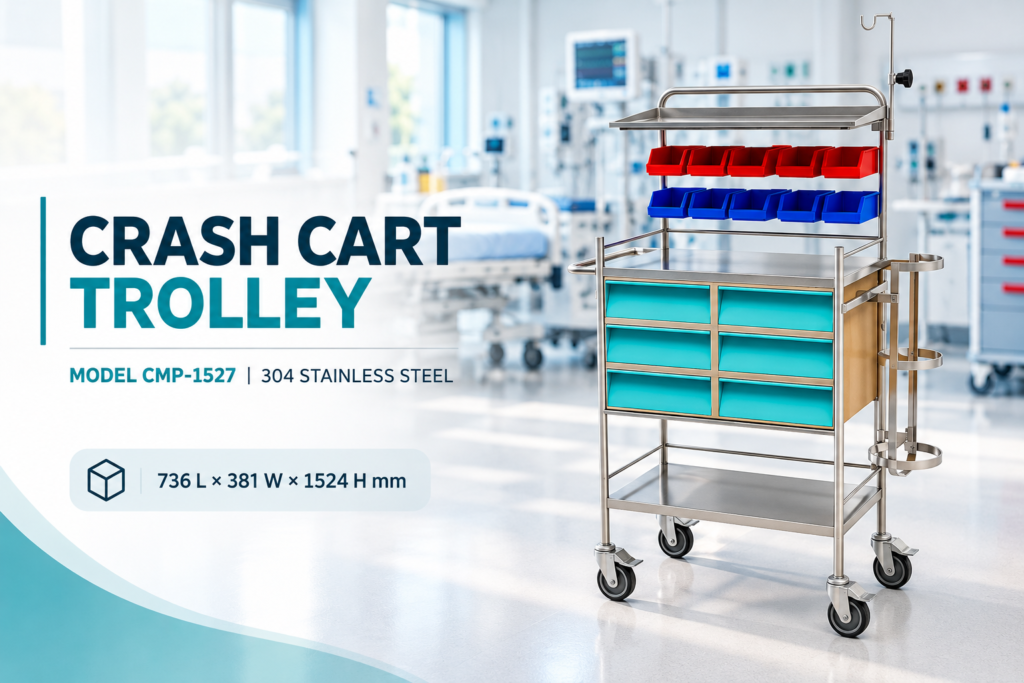
A crash cart trolley is a mobile storage unit designed to hold emergency medicines, airway management supplies, resuscitation equipment, and other critical medical items. It allows healthcare professionals to access essential supplies quickly during cardiac arrest and other medical emergencies.
Most models include multiple drawers, smooth-rolling castors, handles, and dedicated spaces for frequently used equipment. Depending on hospital requirements, additional features may include an IV pole, defibrillator shelf, oxygen cylinder holder, and drawer locking system.
Why Is a Crash Cart Trolley Important?
During a medical emergency, staff need to locate essential supplies without wasting time searching across different storage areas. A properly organized trolley keeps frequently used items together and supports a more coordinated response.
Hospitals use an Emergency Crash Cart Trolley to:
-
Keep emergency medicines and equipment organized.
-
Improve access to supplies during resuscitation.
-
Support rapid movement between treatment areas.
-
Maintain a consistent arrangement of emergency equipment.
-
Help staff conduct routine checks and restocking.
The trolley should be checked regularly according to the hospital’s emergency preparedness procedures. Its availability alone does not guarantee a successful outcome; trained staff, suitable equipment, and established clinical protocols remain essential.
Key Features of a Crash Cart Trolley
When comparing models, hospital procurement teams should evaluate the following features:
-
Stainless steel construction: A Stainless Steel Crash Cart Trolley can provide strength, corrosion resistance, and easy cleaning when the appropriate grade and finish are selected.
-
Multiple storage drawers: Separate drawers help organize medicines, consumables, and emergency accessories.
-
Smooth castor wheels: Quality castors support easy movement through hospital corridors and treatment areas.
-
Locking system: A suitable locking arrangement helps control access to stored supplies.
-
Defibrillator shelf: A dedicated shelf provides a convenient position for compatible emergency equipment.
-
Accessory holders: Optional IV poles, oxygen cylinder holders, and utility baskets can support specific clinical workflows.
-
Easy-to-clean surfaces: Smooth finishes and accessible corners simplify routine cleaning and maintenance.
Benefits of a Crash Cart Trolley
A well-designed trolley offers practical advantages for healthcare facilities:
-
Better organization: Clearly arranged storage makes emergency supplies easier to locate.
-
Improved mobility: Staff can move essential equipment to the required treatment area.
-
Efficient workflow: Organized supplies reduce unnecessary searching during urgent situations.
-
Durability: Appropriate materials and reliable hardware support regular hospital use.
-
Flexible configuration: Different drawer layouts and accessories can meet department-specific requirements.
-
Simplified inspections: An organized layout can make stock checks and replenishment easier.
Applications of a Crash Cart Trolley
A Crash Cart Trolley for ICU use is common, but these mobile units are useful in several hospital departments.
Typical applications include:
-
Intensive Care Units (ICUs)
-
Emergency and trauma departments
-
Operation theatres and recovery rooms
-
Cardiac care units
-
Hospital wards and critical care areas
-
Emergency treatment and resuscitation rooms
-
Multispecialty hospitals and healthcare centres
The required configuration depends on the department, the equipment being stored, and the hospital’s emergency response procedures.
How to Choose the Right Crash Cart Trolley
Before purchasing, compare the trolley’s specifications with your hospital’s operational needs.
-
Check the construction material: Review the stainless steel grade, finish, frame strength, and suitability for the intended environment.
-
Evaluate drawer capacity: Choose a layout that accommodates your medicines, consumables, and emergency equipment.
-
Inspect mobility: Check castor quality, wheel locks, handles, and manoeuvrability.
-
Confirm accessory requirements: Identify whether you need a defibrillator shelf, IV pole, oxygen cylinder holder, or other accessories.
-
Review dimensions: Ensure the trolley fits your storage area, lifts, corridors, and treatment spaces.
-
Compare supplier support: Ask about drawings, available configurations, delivery schedules, warranty terms, and after-sales service.
For bulk procurement, government tenders, or new hospital projects, request technical specifications and drawings before finalizing the purchase.
Common Mistakes to Avoid
Hospital buyers should avoid selecting a trolley based on price alone. Low-cost options may not provide the required construction quality, storage capacity, or mobility.
Other common mistakes include:
-
Ignoring the trolley’s dimensions and load capacity.
-
Choosing an unsuitable material or finish.
-
Overlooking wheel locks and drawer security.
-
Ordering unnecessary accessories or missing essential ones.
-
Failing to confirm maintenance and warranty terms.
-
Not checking compatibility with the hospital’s emergency equipment.
A clear specification sheet helps procurement teams compare suppliers fairly and avoid costly mismatches.
Conclusion
Choosing the right crash cart trolley helps hospitals organize emergency supplies, improve accessibility, and support efficient clinical workflows. Buyers should focus on construction quality, storage layout, mobility, accessories, and supplier support rather than price alone.
CMP METAL manufactures hospital furniture and healthcare equipment, including crash cart trolley solutions. Hospital administrators, procurement managers, distributors, and project consultants can contact the company to discuss available models, product drawings, and configuration requirements.
Frequently Asked Questions
1. What is a crash cart trolley?
A crash cart trolley is a mobile medical cart that stores emergency medicines, resuscitation equipment, and essential supplies. It allows healthcare professionals to move these items to the required treatment area. Hospitals typically keep crash carts in ICUs, emergency departments, cardiac care units, and other locations where urgent medical intervention may be needed.
2. What are the benefits of a crash cart trolley?
A crash cart trolley helps keep emergency supplies organized and accessible. Its drawers separate different types of equipment, while castor wheels allow staff to move the cart when needed. A suitable design can also simplify routine stock checks, cleaning, restocking, and equipment arrangement in busy hospital departments.
3. Where is a crash cart trolley used?
Crash cart trolleys are commonly used in intensive care units, emergency rooms, cardiac care units, operation theatres, recovery rooms, and hospital wards. Their configuration depends on the department’s needs and the supplies stored inside. Healthcare facilities should position and maintain them according to their emergency response policies.
4. How do I choose the right crash cart trolley?
Start by identifying the equipment and medicines the trolley must hold. Then evaluate its material, dimensions, drawer capacity, castors, locking arrangements, and accessory options. Ask the supplier for technical specifications and drawings, and confirm warranty and after-sales support before placing a bulk or project-based order.
5. Is a crash cart trolley customizable?
Many manufacturers offer configurable crash cart trolleys with different drawer layouts, dimensions, shelves, and accessory holders. Available options depend on the manufacturer’s design and production capabilities. Before ordering, share your department requirements, preferred dimensions, equipment list, and any applicable tender specifications to confirm feasibility.
6. Which material is best for a crash cart trolley?
Stainless steel is a common choice for hospital trolleys because it offers strength, corrosion resistance, and a cleanable surface when properly finished and maintained. The appropriate grade depends on the intended environment and cleaning procedures. Buyers should also assess construction quality, joints, hardware, and overall ease of maintenance.
7. Who should buy a crash cart trolley?
Hospital administrators, purchase managers, ICU supervisors, emergency department heads, healthcare project consultants, and medical equipment distributors may need crash cart trolleys. Government hospitals and private healthcare groups may also procure them through tenders or bulk orders. Buyers should define technical requirements before comparing quotations.
8. How often should a crash cart trolley be checked?
Hospitals should inspect crash carts according to their approved clinical protocols and emergency preparedness policies. Checks may cover medicine expiry dates, supply levels, equipment readiness, seals or locks, and wheel condition. The responsible clinical team should document inspections and replenish missing or expired supplies promptly.