

Crash Cart Trolley Manufacturer in India: Features, Benefits and Buying Guide
Introduction
In hospitals, every second matters during a medical emergency. Doctors and nurses need quick access to essential medicines, emergency supplies, and medical instruments to provide timely care. A well-designed crash cart trolley helps healthcare teams keep these critical items organized and ready for use. Choosing a reliable Crash Cart Trolley Manufacturer in India is important for hospitals, intensive care units (ICUs), emergency departments, and operation theatres. The right trolley can improve workflow, support emergency preparedness, and make essential medical supplies easier to access when they are needed most.
Quick Summary: A crash cart trolley is a mobile medical storage unit used to organize emergency medicines, instruments, and supplies in hospitals. It supports rapid response in ICUs, emergency rooms, and operation theatres. Hospitals should evaluate construction quality, drawer layout, mobility, locking systems, cleaning requirements, and customization options before purchasing.
What Is a Crash Cart Trolley?
A crash cart trolley is a mobile medical trolley designed to store and transport emergency medicines, resuscitation equipment, and other essential medical supplies. It allows healthcare professionals to access critical items quickly during cardiac arrest and other life-threatening situations.
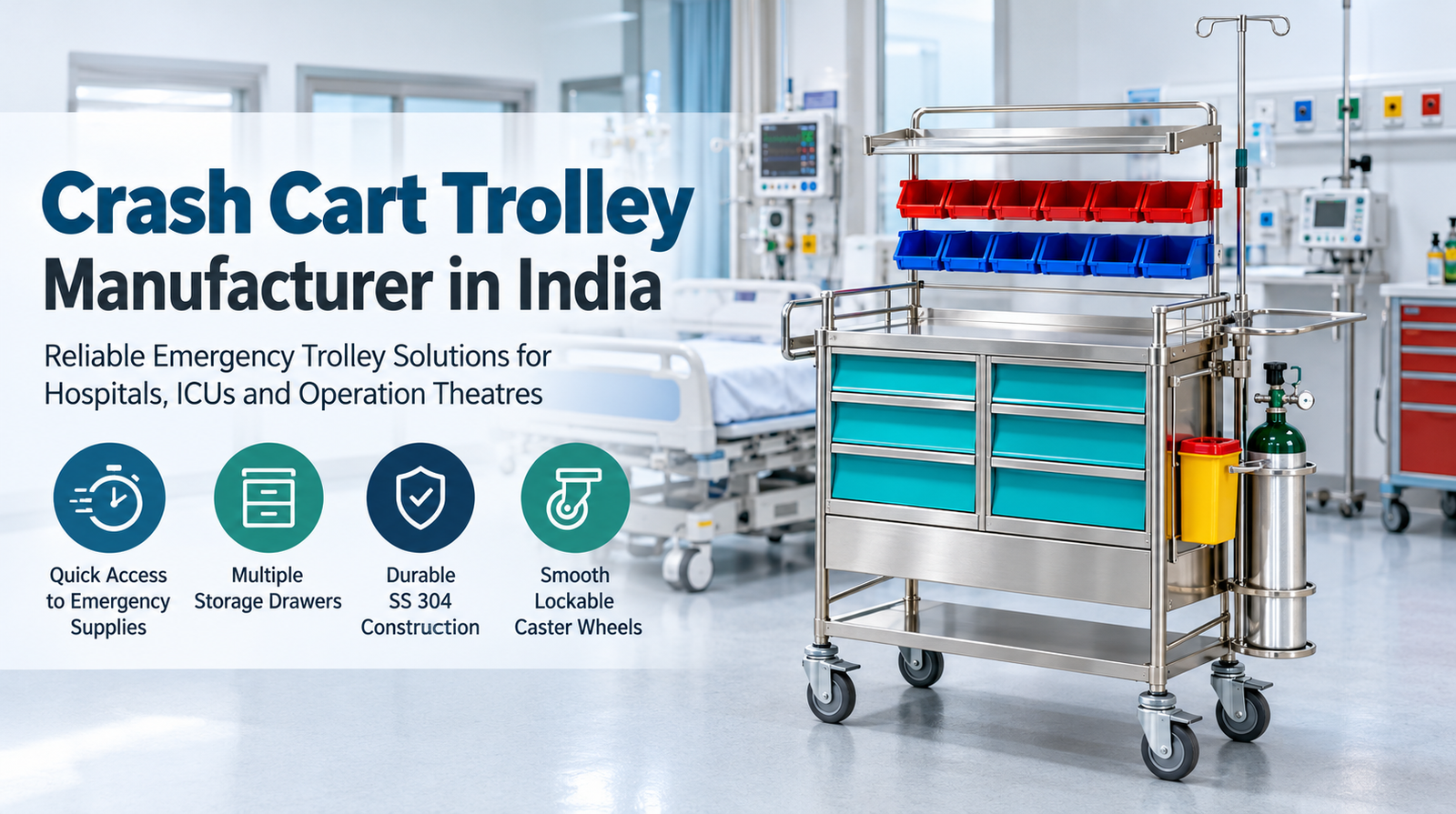
A typical hospital crash cart trolley may include multiple drawers, lockable caster wheels, a handle, medicine trays, and accessories such as an IV pole or defibrillator shelf.
Depending on the hospital’s requirements, buyers can select stainless steel models or other suitable materials. The configuration should support the facility’s emergency protocols and infection-control procedures.
Why Is a Crash Cart Trolley Important?
During emergencies, searching for medicines or equipment can delay treatment. A properly organized emergency crash cart trolley helps staff locate essential supplies without unnecessary movement.
Its practical importance includes:
- Faster access: Clearly organized drawers help staff find emergency supplies quickly.
- Better organization: Dedicated storage areas reduce clutter and improve equipment arrangement.
- Improved mobility: Smooth-rolling wheels allow staff to move the trolley between designated care areas.
- Emergency preparedness: A standardized layout supports routine checks and restocking.
- Safer handling: Suitable brakes, secure storage, and stable construction help reduce operational risks.
Hospitals should also maintain clear inspection, inventory, and replenishment procedures to ensure that emergency supplies remain available.
Key Features of a Hospital Crash Cart Trolley
When comparing products from a crash cart trolley supplier in India, consider these important features:
- Durable construction: Stainless steel or another appropriate material should withstand frequent use and routine cleaning.
- Multiple storage drawers: Separate compartments help organize medicines, consumables, and medical accessories.
- Smooth caster wheels: Quality wheels support easy movement through hospital corridors.
- Reliable braking system: Wheel brakes help keep the trolley stationary during emergency procedures.
- Secure storage: Locking arrangements help control access to medicines and supplies where required.
- Accessory options: An IV pole, defibrillator shelf, oxygen cylinder holder, or CPR board may be useful depending on the application.
- Easy-to-clean surfaces: Accessible surfaces and practical drawer designs support hospital cleaning routines.
Benefits of a Stainless Steel Crash Cart Trolley
A stainless steel crash cart trolley can offer practical advantages in demanding healthcare environments.
- Corrosion resistance: Appropriate stainless steel grades can resist corrosion when maintained correctly.
- Long service life: Strong construction can support frequent movement and daily hospital operations.
- Hygiene support: Smooth surfaces can simplify routine cleaning when compatible with the cleaning products used.
- Organized workflow: Multiple drawers and accessories help keep emergency supplies arranged.
- Customization: Hospitals may request specific dimensions, drawer configurations, and accessories.
The overall performance depends on material grade, fabrication quality, wheel selection, maintenance, and the hospital’s operating conditions.
Applications of an Emergency Crash Cart Trolley
Crash cart trolleys are commonly used in:
- Hospital emergency departments
- Intensive care units (ICUs)
- Cardiac care units
- Operation theatres and recovery rooms
- Multispecialty hospitals
- Trauma and critical care centres
- Specialty clinics with emergency response facilities
- New hospital construction and expansion projects
Their configuration should match the clinical department, available space, emergency equipment, and local operating protocols.
How to Choose the Right Crash Cart Trolley
Before purchasing from a medical emergency trolley manufacturer, evaluate the following points:
- Identify your department’s needs: Determine whether the trolley will be used in an ICU, emergency room, operation theatre, or another clinical area.
- Check the material: Compare stainless steel grade, fabrication quality, corrosion resistance, and cleaning compatibility.
- Review the storage layout: Ensure the drawers can accommodate the required medicines, consumables, and equipment.
- Evaluate mobility and stability: Check wheel quality, manoeuvrability, braking, and stability during use.
- Confirm accessories and customization: Ask about IV poles, defibrillator shelves, CPR boards, and other required components.
- Compare supplier support: Review product specifications, delivery timelines, warranty terms, spare parts availability, and after-sales service.
Hospital procurement teams should also confirm that the selected model meets their internal specifications and applicable purchasing requirements.
Common Mistakes to Avoid
Buyers should avoid choosing a trolley based on price alone. A low initial cost may not represent the best long-term value if the construction, wheels, or drawer mechanisms do not suit daily use.
Other common mistakes include ignoring the available space, selecting an unsuitable drawer layout, overlooking cleaning requirements, and ordering accessories that are incompatible with the intended equipment.
Hospitals should also avoid assuming that purchasing a trolley alone guarantees emergency readiness. Regular inspections, inventory checks, staff training, and restocking are essential parts of an effective emergency response system.
Conclusion
A reliable crash cart trolley helps hospitals organize essential emergency supplies and support efficient clinical workflows. The right model should combine durable construction, practical storage, stable mobility, easy cleaning, and accessories suited to the department’s needs.
When evaluating a Crash Cart Trolley Manufacturer in India, hospital purchase managers, healthcare consultants, and medical equipment distributors should compare specifications, customization options, and supplier support before making a decision.
CMP METAL offers crash cart trolley solutions for healthcare environments. Contact the company to discuss your required dimensions, drawer configuration, accessories, and project specifications.
Frequently Asked Questions
1. What is a crash cart trolley used for?
A crash cart trolley stores and transports emergency medicines, medical instruments, and essential resuscitation supplies. Hospitals use it in ICUs, emergency departments, cardiac care units, and operation theatres. Its organized storage helps healthcare professionals locate required items quickly during critical situations. Regular inspection and restocking are necessary to keep the trolley ready for use.
2. What are the benefits of a stainless steel crash cart trolley?
A stainless steel crash cart trolley can provide durability, corrosion resistance, and surfaces that support routine cleaning. It is suitable for demanding healthcare environments when the material grade and cleaning procedures are appropriate. Its overall performance also depends on fabrication quality, drawer design, wheel construction, and regular maintenance.
3. Where is a hospital crash cart trolley used?
Hospital crash cart trolleys are commonly used in emergency rooms, ICUs, cardiac care units, operation theatres, recovery rooms, and other critical care areas. Hospitals choose the trolley configuration according to the department’s equipment requirements, available space, and emergency procedures. Some specialty clinics also use them when their clinical services require emergency response equipment.
4. How do I choose the right crash cart trolley?
Start by identifying the intended department and the equipment that must be stored. Compare the material grade, drawer capacity, wheel brakes, mobility, cleaning requirements, and accessory options. Ask the supplier for detailed specifications and warranty information. Hospitals should also verify compatibility with their internal procurement standards and emergency response protocols.
5. Can a crash cart trolley be customized?
Yes, many manufacturers offer customization options depending on the product design and project requirements. These may include drawer arrangements, dimensions, IV poles, defibrillator shelves, CPR boards, and oxygen cylinder holders. Buyers should share their equipment list and department requirements before ordering so the manufacturer can confirm feasibility, specifications, and pricing.
6. Which material is best for a crash cart trolley?
The best material depends on the clinical environment, cleaning routine, durability requirements, and budget. Stainless steel, including suitable SS 304 constructions, is often considered for its corrosion resistance and ease of cleaning. Buyers should verify the actual material grade and fabrication details rather than relying only on a general stainless steel product description.
7. What should I check before buying from a crash cart trolley supplier in India?
Check the manufacturer’s specifications, construction quality, material details, available accessories, delivery schedule, warranty, and after-sales support. Request product drawings or technical documentation when necessary. For bulk procurement, also confirm customization feasibility, consistency across units, packaging arrangements, and whether the supplier can meet your project timeline.
8. What is the difference between a crash cart trolley and a regular medical trolley?
A regular medical trolley may be designed for routine medicine distribution, instrument transport, or general storage. A crash cart trolley is specifically configured to organize emergency medicines and resuscitation supplies for rapid access. Its drawer arrangement, accessories, security features, and inspection procedures should support the healthcare facility’s emergency response requirements.