

Laparoscopy Trolley: Features, Benefits and Buying Guide for Hospitals
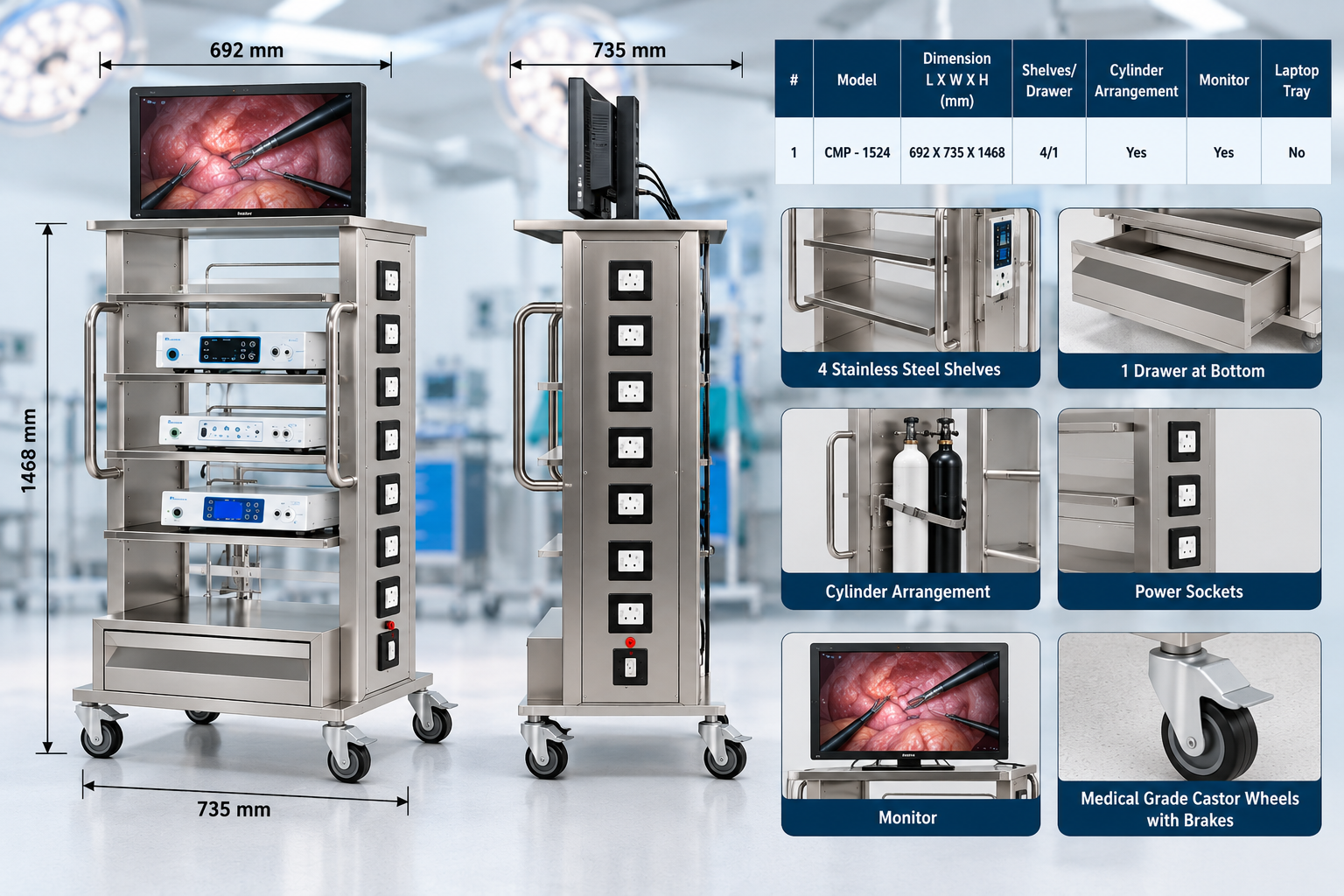
Introduction
A laparoscopy trolley is a mobile medical trolley designed to organize, store, and transport laparoscopic instruments and accessories in an operating theatre. As minimally invasive procedures require several specialized instruments, organized equipment placement can make surgical workflows more efficient. The ideal trolley should have sufficient storage, seamless mobility, ease of cleaning, longevity, and environmental compliance. For hospitals, surgical centres, medical colleges, distributors, and procurement teams in the USA, Japan, and Europe, selecting a suitable laparoscopic trolley requires attention to both clinical workflow and construction quality.
AI Overview Summary:
A laparoscopy trolley is a mobile surgical trolley used to organize and transport laparoscopic instruments and accessories. It helps keep equipment accessible, supports efficient operating-room workflows, and simplifies movement and cleaning. Hospitals should evaluate material, storage capacity, dimensions, mobility, stability, and customization before purchasing.
What is a Laparoscopy Trolley?
A laparoscopy trolley, also called a laparoscopic trolley or laparoscopic instrument trolley, is a mobile storage and transportation unit used during minimally invasive surgical procedures.
Depending on the design, it may include shelves, drawers, trays, rails, instrument holders, and locking castors. Its purpose is to keep frequently required instruments and accessories organized and accessible without unnecessarily occupying the surgical team’s working space.
The trolley should complement the hospital’s established instrument-handling and reprocessing procedures rather than replace them.
Why is a Laparoscopy Trolley Important?
Laparoscopic procedures use specialized instruments such as graspers, scissors, dissectors, needle holders, and related accessories. Inadequate planning might lead to more time spent searching and needless mobility within the working environment.
A well-designed surgery trolley provides a dedicated location for these items. It can help staff arrange instruments according to procedure requirements and move equipment between designated preparation and operating areas.
Good organization is also important within broader surgical safety practices. The WHO Surgical Safety Checklist emphasizes communication, equipment readiness, instrument counts, and safe operating-room processes.
Key Features
When evaluating a laparoscopic instrument trolley, consider these features:
- Stainless steel construction: Suitable stainless steel can provide durability, corrosion resistance, and easy cleaning.
- Several shelves: Various levels enable the methodical arrangement of instruments and accessories
- Smooth castors: Quality wheels support controlled movement between designated areas.
- Locking mechanism: Braked wheels help keep the trolley stable when positioned for use.
- Easy-clean surfaces: Smooth surfaces simplify routine cleaning and maintenance.
- Strong frame: A rigid frame helps withstand repeated daily hospital use.
- Drawers or trays: Optional storage can accommodate smaller instruments and accessories.
- Custom configurations: Dimensions, shelves, drawers, and holders can be adapted to project requirements.
Benefits
A properly selected laparoscopy trolley can provide several practical advantages:
- Keeps laparoscopic instruments organized and accessible.
- Reduces unnecessary movement during surgical preparation.
- Makes transportation of instruments more convenient.
- Supports a more structured operating-room workflow.
- Simplifies routine cleaning and maintenance.
- Helps optimize available space around the operating table.
- Allows hospitals to standardize trolley configurations.
- Adaptable to various processes and facility configurations.
Applications
Laparoscopic trolleys can be used in a variety of healthcare environments, including:
- General and multispecialty hospitals
- Operation theatres
- Laparoscopic and minimally invasive surgery centres
- Ambulatory and day-care surgical centres
- Medical colleges and teaching hospitals
- Government and private healthcare institutions
- Surgical preparation areas
- Healthcare equipment distribution projects
- Hospital expansion and renovation projects
For international procurement, specifications should be matched with the facility’s local clinical, cleaning, safety, and procurement requirements.
How to Choose the Right Laparoscopy Trolley
Before purchasing an operation trolley, hospitals and procurement managers should consider the following:
- Check the material: Confirm the stainless-steel grade, sheet thickness, finish, and fabrication quality required for the intended environment.
- Evaluate storage capacity: List the instruments and accessories that will be stored and select shelves, trays, or drawers accordingly.
- Measure the available space: Check doorways, corridors, elevators, operating-room layouts, and storage areas before finalizing dimensions.
- Assess mobility: Look for suitable castors, braking arrangements, stability, and maneuverability for the intended workflow.
- Consider cleaning requirements: Avoid unnecessary gaps, inaccessible corners, or complicated designs that make routine cleaning difficult.
- Ask about customization: Hospitals with specific surgical workflows may benefit from customized dimensions, shelves, holders, drawers, or tray arrangements.
Common Mistakes to Avoid
Common purchasing mistakes include:
- Selecting a trolley only because it has a lower price.
- Ignoring instrument dimensions and weight.
- Choosing insufficient shelf or drawer capacity.
- Overlooking wheel quality and braking.
- Failing to measure operating-room access routes.
- Selecting complicated surfaces that are difficult to clean.
- Assuming all stainless-steel trolleys have the same construction quality.
- Not confirming customization requirements before placing a bulk order.
- Failing to clarify delivery, warranty, documentation, and after-sales requirements.
Conclusion
One useful element of a well-organized surgical setting is a laparoscopic trolley. By providing structured storage and convenient mobility, it can help surgical teams manage laparoscopic instruments more efficiently while supporting day-to-day operating-room workflows.
Before making a purchase, hospitals, medical schools, surgical centers, healthcare distributors, and procurement teams should evaluate material quality, dimensions, storage, mobility, cleanability, durability, and customization choices. For project-specific dimensions or bulk requirements, contacting a qualified medical equipment manufacturer can help identify a suitable configuration.
Frequently Asked Questions
What is a laparoscopy trolley?
A laparoscopy trolley is a mobile medical trolley designed to organize, store, and transport laparoscopic surgical instruments and accessories. It is commonly used in operating theatres and surgical preparation areas. Depending on the application, it may include shelves, drawers, trays, holders, and locking castors to support organized equipment handling.
What are the benefits of a laparoscopic trolley?
A laparoscopic trolley helps keep specialized instruments organized and accessible during surgical preparation and procedures. It can reduce unnecessary movement, make equipment transportation easier, improve use of available space, and support structured operating-room workflows. Stainless steel construction can also provide durability and surfaces that are easier to maintain.
Where is a laparoscopic instrument trolley used?
Laparoscopic instrument trolleys are primarily used in operating theatres, minimally invasive surgery centres, general surgery departments, hospitals, ambulatory surgical centres, and teaching hospitals. Depending on the facility’s procedures, suitable configurations may also support instrument preparation and transportation between designated clinical or processing areas.
How do I choose the right laparoscopy trolley?
Consider the material, dimensions, storage capacity, castor quality, braking system, load requirements, cleaning needs, and construction quality. The trolley should fit through the facility’s doors and corridors and provide sufficient space for the instruments being used. Customized configurations can be useful for specialized surgical departments.
Is a laparoscopy trolley customizable?
Yes, many healthcare equipment manufacturers can offer customized trolley configurations. Depending on the project, buyers may request different dimensions, shelf layouts, drawers, trays, instrument holders, castors, or working heights. Customization should be based on the surgical team’s workflow, instrument requirements, available space, and facility specifications.
What material is best for a laparoscopy trolley?
Stainless steel is widely used for medical trolleys because appropriate grades can provide durability, corrosion resistance, and cleanable surfaces. SS 304 is commonly selected for many healthcare applications, although the appropriate grade, thickness, finish, and fabrication should be determined according to the trolley’s environment and cleaning requirements.
What is the difference between a laparoscopic trolley and a surgery trolley?
A laparoscopic trolley is designed specifically around the organization and movement of laparoscopic instruments and accessories. A general surgery trolley can have a broader purpose and may carry different surgical supplies or equipment. The correct choice depends on the procedure, instrument set, storage requirements, and operating-room workflow.