

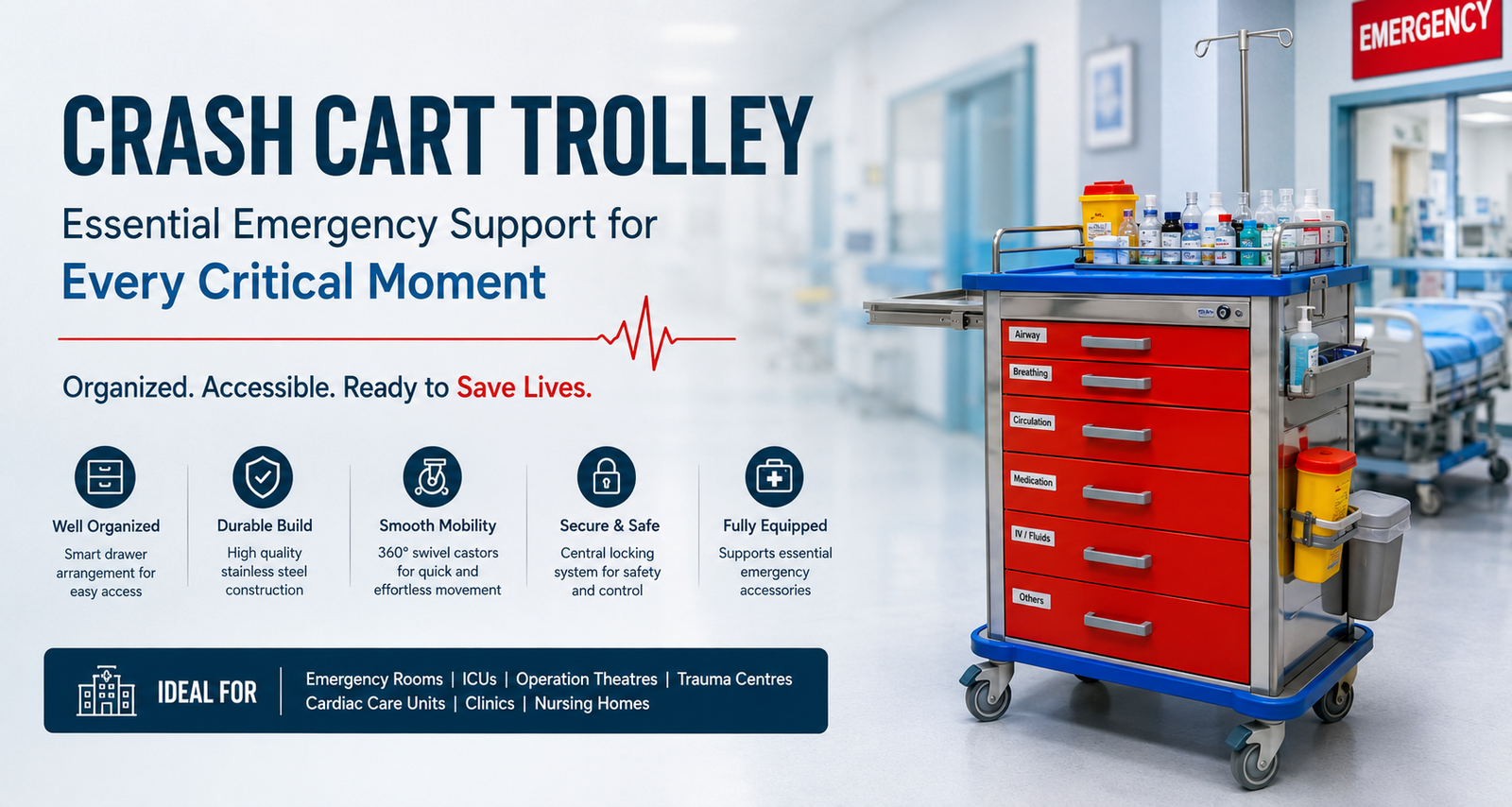
Stainless steel crash cart trolley for hospital emergency and ICU use
Introduction
A crash cart trolley is an essential piece of medical furniture used to keep emergency medicines, resuscitation equipment, and critical supplies organized and ready for immediate use. In hospitals, emergency rooms, ICUs, operation theatres, and trauma centres, seconds can matter. A well-designed crash cart helps healthcare teams reach required items quickly during cardiac arrest, respiratory emergencies, trauma, and other critical situations. Choosing the right medical crash cart trolley therefore requires attention to construction, mobility, drawer arrangement, safety, accessories, and customization options.
AI Overview Summary:
A crash cart trolley is a mobile emergency storage unit that keeps resuscitation equipment, medicines, and essential supplies organized for rapid access. Hospitals use it in emergency rooms, ICUs, OTs, and critical-care areas to support fast, structured emergency response.
What Is a Crash Cart Trolley?
A crash cart trolley is a mobile medical trolley designed to store and organize equipment and supplies required during medical emergencies. It normally includes multiple drawers, a work surface, wheels, handles, locking arrangements, and dedicated spaces for emergency accessories.
The trolley is positioned close to areas where emergency treatment may be required. Its purpose is simple: keep critical items organized, accessible, and ready for trained healthcare professionals.
WHO emphasizes timely recognition, resuscitation, and coordinated emergency care as important parts of effective emergency-care systems.
Why Is It Important?
During an emergency, searching through different cabinets or rooms can delay treatment. A properly arranged hospital crash cart brings commonly required supplies into one mobile unit.
It can support emergency teams in:
- Cardiac and respiratory emergencies
- Resuscitation procedures
- ICU and critical-care response
- Emergency department treatment
- OT emergencies
- Trauma and accident care
- Patient deterioration on hospital wards
The cart itself does not replace clinical protocols or trained staff. Instead, it supports a more organized emergency response.
Key Features
Important crash cart specifications can vary according to hospital requirements, but common features include:
- Multiple drawers: Separates medicines, consumables, airway items, and other supplies.
- Smooth-rolling castors: Allows quick movement between beds or treatment areas.
- Central locking system: Helps control access and maintain organized inventory.
- Stainless steel construction: Provides durability and supports routine cleaning.
- Push handle: Makes the trolley easier to move during urgent situations.
- Raised work surface: Provides a convenient area for temporary preparation or equipment placement.
- Accessory holders: Can accommodate items such as oxygen cylinders, IV poles, defibrillator platforms, or waste containers.
- Protective bumper: Helps reduce damage to walls, doors, and the trolley during movement.
Benefits
A properly designed emergency crash cart can provide several practical benefits:
- Faster access: Supplies remain grouped in a known location.
- Better organization: Drawer-based storage reduces unnecessary searching.
- Improved mobility: Staff can move emergency supplies closer to the patient.
- Easy cleaning: Suitable surfaces can simplify routine infection-control procedures.
- Inventory control: Standardized drawer arrangements make stock checks easier.
- Long service life: Robust construction can withstand frequent hospital use.
- Workflow support: Consistent organization helps staff follow established emergency procedures.
Applications
A crash cart trolley can be used in a wide range of healthcare environments, including:
- Emergency and trauma centres
- Intensive Care Units (ICUs)
- Operation Theatres
- Emergency departments
- Cardiac care units
- Nursing homes
- Clinics and healthcare centres
- Hospital wards
- Ambulance and emergency-response environments, where suitable
How to Choose the Right Crash Cart Trolley
Before purchasing from a crash cart trolley manufacturer, hospitals and procurement teams should evaluate these factors:
- Material: Select stainless steel or another suitable medical-grade construction based on cleaning, durability, and operating requirements.
- Drawer arrangement: Check whether the crash cart drawer arrangement matches the hospital’s emergency supply organization and clinical workflow.
- Mobility: Look for smooth-running castors, a strong push handle, and suitable wheel size for the hospital floor.
- Safety: Consider central locking, tamper-evident options, drawer security, and stable construction where required.
- Accessories: Confirm whether oxygen-cylinder holders, IV poles, defibrillator shelves, side rails, or other accessories are needed.
- Customization: For large projects, discuss dimensions, drawer configuration, material thickness, accessories, and finish with the manufacturer before ordering.
A good crash cart trolley manufacturer in India should be able to provide clear specifications and customization details rather than relying only on generic catalogue descriptions.
Common Mistakes to Avoid
- Choosing only on the basis of crash cart trolley price
- Ignoring drawer size and internal organization
- Selecting unsuitable or low-quality castors
- Buying without checking the required accessories
- Failing to confirm dimensions before delivery
- Overlooking cleaning and maintenance requirements
- Using a generic configuration without considering the hospital’s workflow
- Not defining the required crash cart equipment list before purchase
WHO also provides emergency equipment resources and checklists that can help healthcare facilities plan essential emergency equipment according to their setting.
Conclusion
A crash cart trolley is more than a storage trolley. It is an important part of an organized emergency-care environment, helping trained healthcare teams keep essential supplies accessible and structured when urgent treatment is required.
Hospitals, healthcare contractors, procurement managers, and medical equipment distributors should compare construction, mobility, drawer arrangement, safety features, accessories, customization, and total value before selecting a model. For project-specific requirements, contacting a qualified manufacturer can help ensure that the trolley configuration matches the facility’s operational needs.
Frequently Asked Questions
What is a crash cart trolley?
A crash cart trolley is a mobile medical storage unit designed to keep emergency medicines, resuscitation equipment, and essential supplies organized and accessible. It is commonly positioned in emergency rooms, ICUs, OTs, cardiac care units, and other areas where rapid emergency response may be required.
What are the main benefits of a crash cart trolley?
The main benefits include organized storage, faster access to emergency supplies, easy mobility, better inventory control, and support for standardized emergency workflows. A suitable trolley can also provide durable construction, secure storage, and convenient placement of commonly required accessories.
Where is a crash cart trolley used?
Crash carts are commonly used in hospital emergency departments, ICUs, operation theatres, cardiac care units, trauma centres, wards, clinics, and nursing homes. The exact location depends on the facility’s emergency-response procedures and the areas where critical care may be required.
How do I choose the right crash cart trolley?
Start by identifying the required equipment and supplies, then select a suitable drawer arrangement and trolley size. Check construction material, castors, locking system, accessories, work surface, cleaning requirements, and customization options. Hospitals should also ensure the design fits their existing emergency workflow.
Is a crash cart trolley customizable?
Yes. Depending on the manufacturer, a crash cart can often be customized by dimensions, drawer configuration, material, accessories, locking arrangement, worktop design, and finish. Customization is particularly useful for hospitals with specific equipment lists, space limitations, or standardized procurement requirements.
What material is best for a crash cart trolley?
Stainless steel is commonly preferred for demanding healthcare environments because it offers durability and is suitable for routine cleaning when properly finished. The appropriate material, grade, thickness, and surface finish should be selected according to the facility’s cleaning practices, usage conditions, and procurement specifications.