

Wall Mounted Instrument Washing Sink: A Practical Guide for Hospitals and CSSD
Introduction
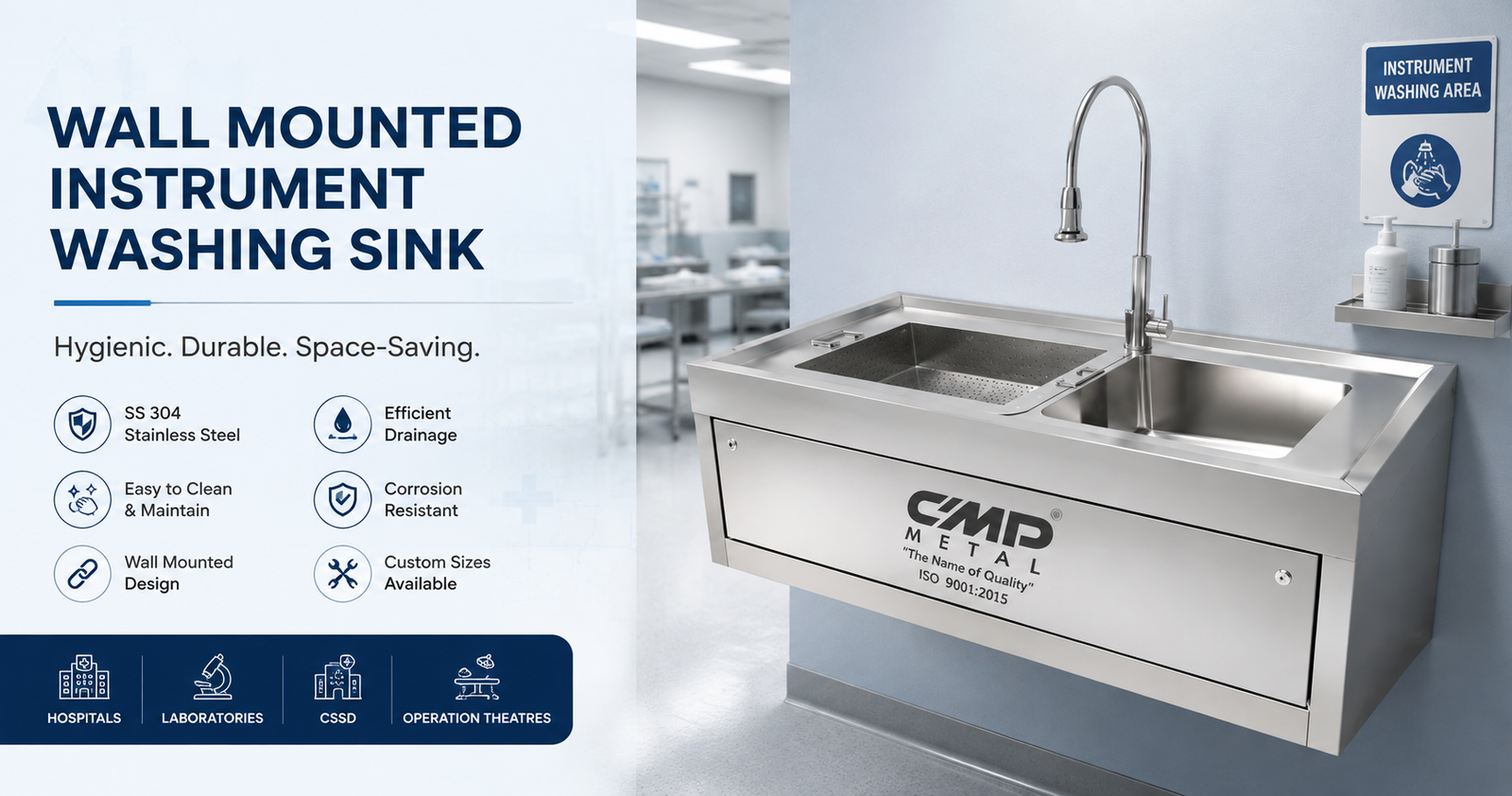
A Wall Mounted Instrument Washing Sink is designed for cleaning and handling surgical instruments in hospitals, operation theatres, CSSD departments, and medical laboratories. Unlike conventional floor-mounted sinks, its wall-mounted design saves floor space and can make cleaning around the sink easier. For healthcare facilities, choosing the right sink involves more than size and appearance. Material quality, hygiene, drainage, installation, workflow, and customization all affect long-term performance and usability.
AI Overview Summary: A Wall Mounted Instrument Washing Sink is a hygienic stainless steel sink fixed to a wall for washing and handling medical instruments. It is commonly used in hospitals, OT, CSSD, and laboratories because it saves floor space, supports easier cleaning, and can be configured for demanding healthcare workflows.
What is a Wall Mounted Instrument Washing Sink?
A Wall Mounted Instrument Washing Sink is a stainless steel washing station installed directly against a wall instead of being supported primarily by the floor. It provides a dedicated area for washing surgical and medical instruments before further processing, disinfection, sterilization, or storage.
These sinks are commonly manufactured using stainless steel because the material is durable, corrosion-resistant, non-porous, and relatively easy to clean. An SS 304 Instrument Washing Sink is often preferred for healthcare environments where regular exposure to water and cleaning chemicals is expected.
Why is it Important?
Instrument washing is an important part of healthcare hygiene and reprocessing workflows. A properly designed Hospital Instrument Washing Sink gives staff a dedicated work area and helps separate instrument cleaning from general handwashing or other activities.
The wall-mounted configuration can also be useful where floor space is limited. Open floor space underneath the sink can make routine cleaning easier and may support better housekeeping practices.
In CSSD and OT environments, the sink can be positioned according to the movement of instruments between washing, inspection, packing, and sterilization areas.
Key Features
- SS 304 construction: Provides a durable and corrosion-resistant surface suitable for demanding healthcare environments.
- Wall-mounted design: Uses vertical wall space and reduces the footprint required on the floor.
- Smooth welded surfaces: Minimize areas where dirt and contaminants can accumulate.
- Easy-clean finish: Supports routine cleaning and maintenance.
- Efficient drainage: Helps remove wastewater quickly from the washing area.
- Backsplash option: Helps protect the surrounding wall from water splashes.
- Custom dimensions: Can be manufactured according to available space and workflow requirements.
- Tap and accessory provisions: Can accommodate suitable faucets, drains, and other required fittings.
Benefits
- Better space utilization: A wall-mounted design can be particularly useful in compact OT, CSSD, and laboratory areas.
- Easier floor cleaning: The open area below the sink can provide better access for housekeeping.
- Improved workflow: A dedicated washing station helps organize instrument-processing activities.
- Long service life: Stainless steel construction can withstand regular washing and cleaning.
- Hygienic working surface: Non-porous stainless steel is easier to clean than many porous materials.
- Flexible installation: Dimensions and configurations can be adapted to project requirements.
Applications
A Wall Mounted SS Sink for Hospital can be used in several healthcare and institutional environments, including:
- Operation Theatres and OT preparation areas
- Central Sterile Services Departments (CSSD)
- Hospitals and multispecialty healthcare facilities
- Clinics and surgical centers
- Diagnostic and medical laboratories
- Medical colleges and teaching hospitals
- Healthcare facility projects and new hospital construction
- Government and institutional healthcare procurement projects
How to Choose the Right Wall Mounted Instrument Washing Sink
Before purchasing, healthcare buyers and project teams should evaluate the following:
- Check the material: SS 304 is generally a practical choice for healthcare washing applications requiring good corrosion resistance and durability.
- Confirm dimensions: Measure the installation area and select a sink that supports the required working space without obstructing movement.
- Review the bowl configuration: Consider single, double, or customized bowl arrangements according to instrument-processing requirements.
- Evaluate drainage: Ensure the drain size and position are appropriate for efficient wastewater removal.
- Check installation support: Confirm wall structure, mounting arrangement, load capacity, and installation requirements before ordering.
- Consider customization: For hospital projects, features such as backsplash, shelves, taps, drainboards, and specific dimensions may be required.
Common Mistakes to Avoid
A common mistake is choosing a sink based only on price or external appearance. Healthcare buyers should verify the stainless steel grade, construction quality, dimensions, drainage, and installation method.
Another mistake is ignoring the wall structure. A wall-mounted sink requires adequate support, particularly when it will regularly carry instruments, water, and cleaning loads.
Buyers should also avoid selecting a standard size without checking the actual workflow and available space. For institutional projects, drawings, specifications, and installation requirements should be reviewed before final procurement.
Conclusion
A Wall Mounted Instrument Washing Sink can provide a practical, hygienic, and space-efficient washing solution for hospitals, OT areas, CSSD departments, and laboratories. SS 304 construction, suitable drainage, strong wall mounting, easy-clean surfaces, and application-specific dimensions are important factors when selecting a model.
For a healthcare project, buyers should discuss dimensions, configuration, material grade, accessories, and installation requirements with the manufacturer before finalizing the specification. This helps ensure that the selected sink fits both the facility and its instrument-processing workflow.
Frequently Asked Questions
What is a Wall Mounted Instrument Washing Sink?
A Wall Mounted Instrument Washing Sink is a stainless steel sink fixed to a wall for washing and handling surgical or medical instruments. It is commonly installed in hospitals, operation theatres, CSSD departments, laboratories, and other healthcare areas where dedicated instrument-cleaning facilities are required.
What are the benefits of a Wall Mounted Instrument Washing Sink?
Its main benefits include efficient floor-space utilization, easier cleaning around the installation area, durable stainless steel construction, and suitability for organized instrument-washing workflows. The design can also be customized for specific room dimensions, bowl configurations, drainage requirements, and accessories used in healthcare facilities.
Where is a Wall Mounted Instrument Washing Sink used?
It is commonly used in CSSD departments, operation theatres, hospitals, surgical centers, medical laboratories, clinics, and institutional healthcare facilities. It can be installed wherever medical instruments require a dedicated washing station as part of an organized cleaning and reprocessing workflow.
How do I choose the right Wall Mounted Instrument Washing Sink?
Consider the available installation space, stainless steel grade, sink dimensions, bowl configuration, drainage arrangement, wall strength, accessories, and cleaning requirements. For new hospital projects, the sink should also be evaluated against the room layout and instrument-processing workflow before procurement.
Is a Wall Mounted Instrument Washing Sink customizable?
Yes. Depending on the manufacturer and project requirements, customization can include overall dimensions, bowl size and number, backsplash, drainboard, tap provisions, drainage position, mounting arrangement, and additional accessories. Custom fabrication can be useful when the sink must fit a specific CSSD, OT, or laboratory layout.
What material is best for an Instrument Washing Sink?
Stainless steel is widely used for healthcare washing sinks because it is durable, non-porous, corrosion-resistant, and easy to clean. SS 304 is a commonly specified grade for many healthcare applications. The appropriate grade should ultimately be selected according to the facility’s environment, cleaning chemicals, specifications, and project requirements.