

Crash Cart Trolley: Essential Emergency Equipment for Hospitals
Introduction
In a medical emergency, every second matters. Healthcare teams need essential medicines, instruments, and emergency equipment available in the right place without delay. A Crash Cart Trolley provides a mobile, organized storage solution for critical supplies used during cardiac arrest, trauma, respiratory emergencies, and other life-threatening situations. Designed for hospitals, ICUs, emergency rooms, operation theatres, and clinics, the trolley helps medical staff access essential equipment quickly while keeping emergency supplies organized and ready for use.
What is a Crash Cart Trolley?
A Crash Cart Trolley is a mobile hospital trolley used to store and organize emergency medicines, medical instruments, consumables, and resuscitation equipment.
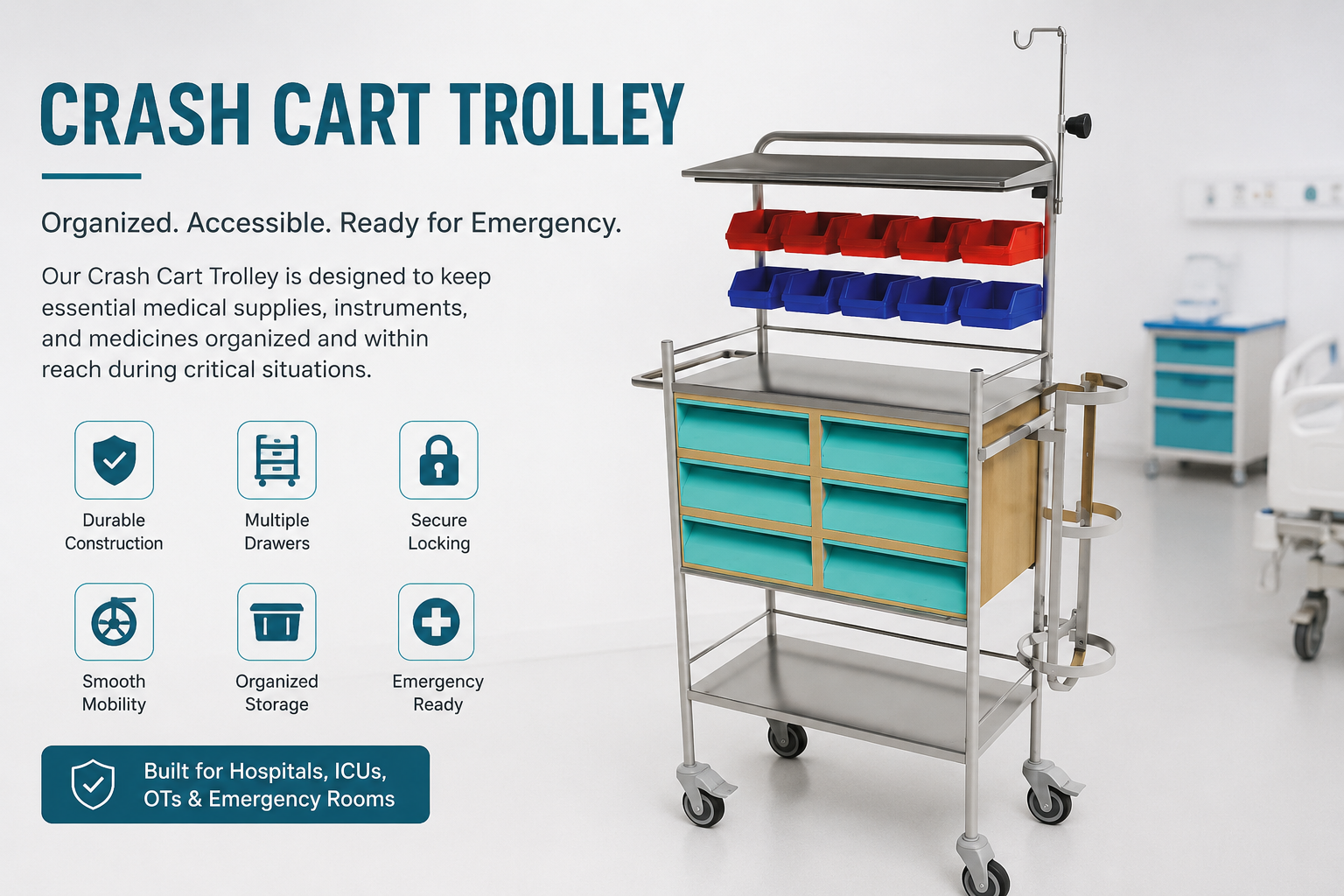
It normally includes multiple drawers, shelves or compartments, castor wheels, and dedicated spaces for frequently required emergency items. The exact crash cart trolley equipment depends on the hospital’s clinical protocols and department requirements.
A well-designed trolley keeps essential supplies close to the patient and supports a structured emergency response. WHO guidance also emphasizes keeping essential resources accessible in resuscitation areas.
Why is it Important?
During cardiac arrest or another critical event, healthcare professionals cannot afford to search through different storage areas for essential supplies.
An emergency crash cart trolley allows commonly required items to be organized in one mobile unit. It can be positioned close to treatment areas and moved when necessary.
This makes it particularly useful in emergency departments, ICUs, critical care units, OTs, and other areas where rapid intervention is required.
Key Features
- Multiple drawers: Separate medicines, instruments, and consumables for faster identification.
- Strong construction: Stainless steel or other suitable materials provide durability for demanding hospital environments.
- Smooth castor wheels: Allow the trolley to be moved quickly between treatment areas.
- Locking system: Helps control access to medicines and emergency supplies.
- Organized compartments: Support logical crash cart trolley arrangements based on department protocols.
- IV pole or accessories: Some configurations include additional supports for emergency procedures.
- Easy-clean surfaces: Smooth surfaces simplify routine cleaning and maintenance.
Benefits
- Faster access to emergency supplies.
- Better organization of critical equipment.
- Easier movement between hospital departments.
- Reduced clutter around emergency treatment areas.
- Improved readiness for urgent clinical situations.
- Flexible storage based on hospital requirements.
Applications
Crash carts are used across hospitals and healthcare facilities, including:
- Emergency and trauma centers
- Intensive Care Units (ICU)
- Operation Theatres (OT)
- Multi-specialty hospitals
- Clinics and nursing homes
- Medical colleges and teaching hospitals
- Government and private healthcare institutions
They may also be configured alongside related equipment, including a crash cart and line trolley, depending on workflow and clinical requirements.
How to Choose the Right Crash Cart Trolley
Before purchasing from a crash cart trolley manufacturer, healthcare institutions should evaluate:
- Material: Select durable, corrosion-resistant material suitable for frequent cleaning.
- Size: Ensure the trolley fits easily through doors, corridors, and treatment areas.
- Storage: Check drawer quantity, compartment layout, and available working space.
- Mobility: Choose reliable castor wheels with appropriate locking mechanisms.
- Safety: Consider drawer locks, seals, and controlled-access requirements.
- Customization: Confirm whether dimensions, drawer layouts, accessories, and finishes can be adapted to hospital requirements.
WHO notes that medical equipment selection should consider the type of healthcare facility, available workforce, and local requirements rather than relying on a single universal configuration?
Common Mistakes to Avoid
Common purchasing mistakes include choosing a trolley based only on price, ignoring corridor and door dimensions, selecting insufficient storage, overlooking wheel quality, and failing to define how emergency supplies will be organized.
Hospitals should also establish clear checking and replenishment procedures so essential equipment and consumables remain ready for use.
Conclusion
A Crash Cart Trolley is an important part of organized emergency preparedness in healthcare environments. The right design can improve accessibility, mobility, storage, and workflow during critical situations. Hospitals should select a trolley according to department requirements, equipment load, available space, safety needs, and maintenance practices. For customized specifications or product information, healthcare institutions can contact a qualified manufacturer to discuss their requirements.
Frequently Asked Questions
What is a Crash Cart Trolley?
A Crash Cart Trolley is a mobile medical storage unit designed for emergency situations. It keeps medicines, instruments, consumables, and resuscitation equipment organized and readily accessible. Hospitals commonly position crash carts in emergency rooms, ICUs, operation theatres, and other areas where rapid medical intervention may be required.
What are the benefits of a Crash Cart Trolley?
The main benefits include quick access to emergency supplies, better organization, easy mobility, efficient storage, and improved emergency preparedness. A properly arranged trolley can help healthcare professionals locate required items faster while reducing unnecessary movement during urgent clinical situations.
Where is a Crash Cart Trolley used?
Crash carts are commonly used in emergency departments, intensive care units, operation theatres, trauma centers, clinics, nursing homes, and multi-specialty hospitals. They can also be used in medical colleges, teaching hospitals, and other healthcare institutions that require organized emergency equipment.
How do I choose the right Crash Cart Trolley?
Consider the trolley’s material, dimensions, storage capacity, drawer configuration, wheel quality, locking system, and customization options. The design should match the hospital’s emergency protocols and available space. It is also important to consider how frequently the trolley will be moved and cleaned.
Is a Crash Cart Trolley customizable?
Yes, many hospital equipment manufacturers offer customized configurations. Hospitals may request different dimensions, drawer arrangements, storage compartments, accessory holders, IV poles, locking systems, or other features according to their workflow and departmental requirements.
What material is best for a Crash Cart Trolley?
Stainless steel is commonly preferred for healthcare environments because it offers durability, corrosion resistance, and easy cleaning. The final material and finish should be selected according to the trolley’s intended application, cleaning procedures, operating environment, and hospital requirements. WHO recommends selecting medical equipment according to facility-specific needs.